
When I assess an indoor rabbit space, I do not start with the cage label or the price of the enclosure. I get down to rabbit height and follow the route the animal can actually take: where they can stretch, where their feet lose traction, what they can chew, where they can hide, and whether food, water and the litter tray can be reached without crossing a frightening or slippery area.
That walk-through usually finds more useful problems than a shopping list does. A safe indoor setup gives rabbits enough connected space to move normally, a quiet shelter they may enter and leave, dry non-slip footing, places to forage and hide, and protection from household hazards.
Choose the footprint before choosing furniture
Measure the full area that will remain available, including the exercise area. Rabbits need room to run, hop, turn, stand upright without their ears touching the top, and lie fully stretched. The Rabbit Welfare Association & Fund and the RSPCA use a minimum guideline of 3 m by 2 m with 1 m of height for a pair of medium rabbits. Larger breeds and groups need more.
A small commercial cage does not become adequate because the door opens for a few hours. A connected pen or a rabbit-proofed room gives the rabbit choice throughout the periods when rabbits are naturally active, including early morning, evening and overnight. I treat the enclosed shelter as a rest area within the larger living space, not as the whole home.
Divide the space by function
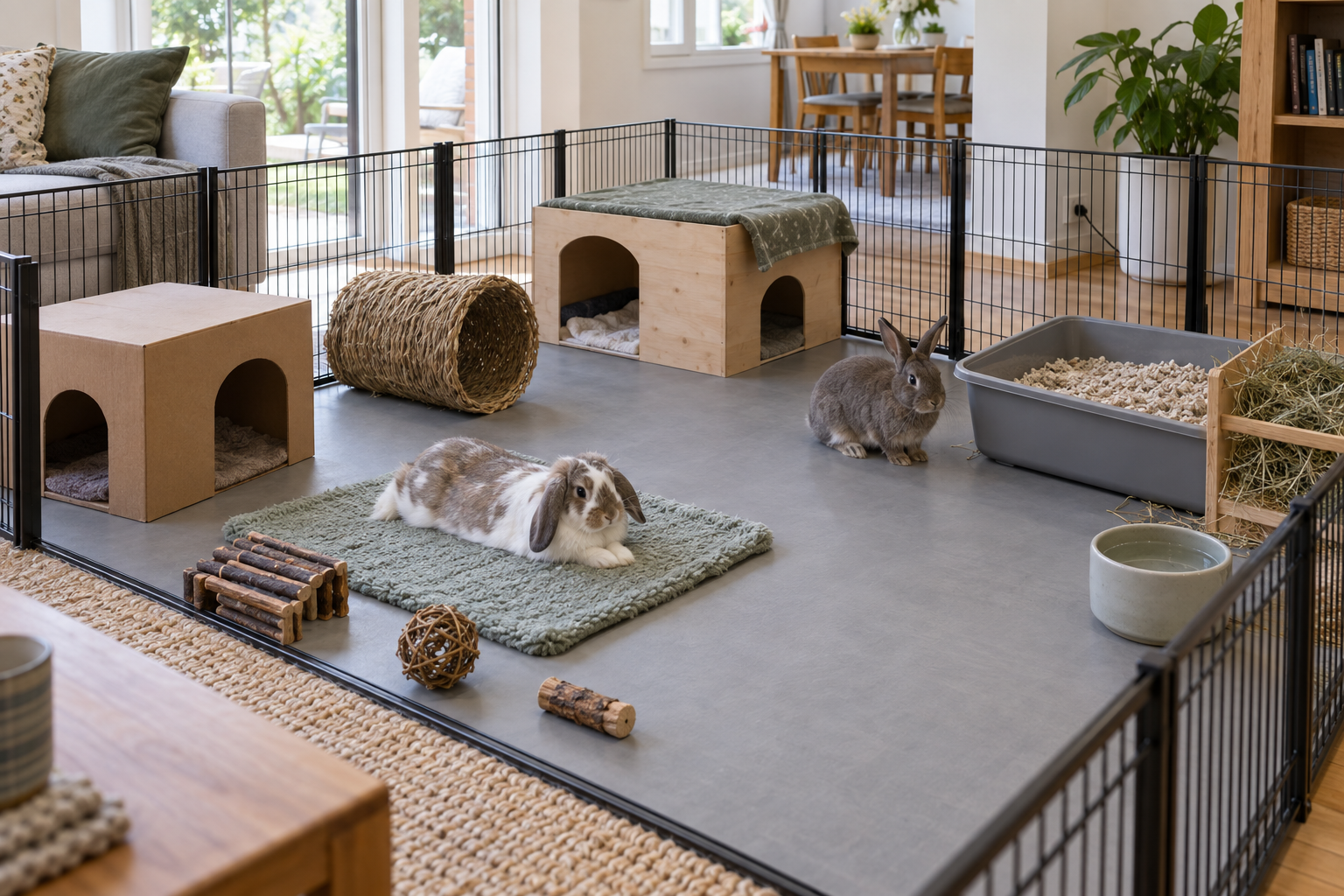
I sketch four zones before placing anything: an open movement lane, a quiet resting area, a toilet-and-hay area, and an enrichment area. The zones may overlap, but objects should not fill every gap. A rabbit should not have to squeeze between a litter tray and a pen panel to reach water.
- Rest: provide a darkened shelter large enough for the rabbits to rest together if they choose.
- Hide: use one hiding place per rabbit plus an extra where possible. Two openings reduce the chance that one rabbit blocks another inside.
- Toilet and hay: place hay in a rack or safe container beside the litter tray so it stays accessible and reasonably clean.
- Water: use a clean bowl or another system the rabbits reliably use, placed where it cannot be contaminated by litter.
- Movement: preserve an uncluttered route long enough for normal hopping and running.
Test the floor with a rabbit’s movement in mind
Solid flooring is essential, but solid does not automatically mean suitable. Polished wood, tile and smooth plastic can cause a rabbit to move cautiously or splay the legs. Add a secure, washable non-slip surface and watch the edges for chewing. Loose towels can bunch under the feet, and foam mats are unsafe if a rabbit removes and swallows pieces.
Check the floor again after normal use: is it dry, does the covering stay flat, and can urine reach a layer that cannot be cleaned? Wire or mesh should not be the standing surface. During routine cleaning, look at the heel fur for thinning, redness, scabs or moisture. The rabbit grooming and cleaning guide shows how to combine that check with coat and bottom care without forcing the rabbit onto their back.
Set up the litter area for observation as well as cleaning
Choose a tray large enough for the rabbit to turn around and sit comfortably. A low entry can help older rabbits or rabbits with limited mobility. Use a non-clumping, non-expanding litter that is appropriate for rabbits; avoid clumping clay and strongly scented products. Putting some used but unsoiled litter or droppings in the tray can help establish the toilet location.
The tray is also a daily health-check station. A sudden change in fecal quantity, pellet size, urine output or litter habits can be an early warning. Our rabbit health warning signs guide explains which changes need a prompt call to a rabbit-experienced veterinarian.
Rabbit-proof every reachable route
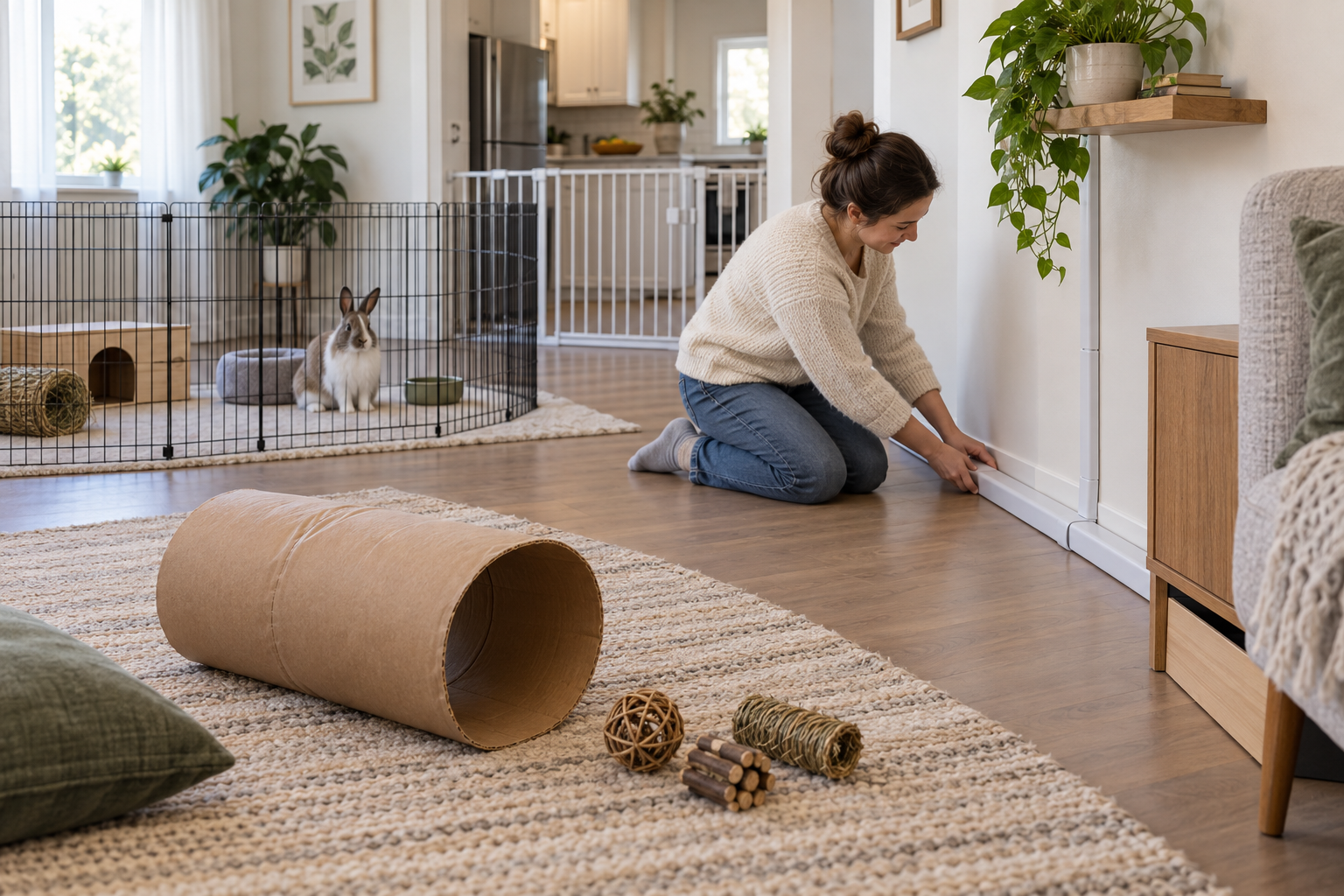
I test rabbit-proofing with the pen open and move clockwise around the room. Electrical cords must be fully enclosed in rigid protection or moved completely out of reach; a loose fabric sleeve is not enough for an energized cable. Block access behind appliances, under reclining furniture and into kitchens or utility areas. Check baseboards, carpet edges, low shelves, cleaning products and any object that could fall when pulled.
Houseplants require identification rather than guesswork. Keep toxic or unknown plants outside the accessible room and high enough that fallen leaves cannot land inside the pen. Gates and pen panels must be tall and stable enough for the individual rabbit, with openings too small for the head to become trapped.
Control heat, drafts, noise and household traffic
Place the enclosure away from radiators, fireplaces, direct sun, kitchen heat and strong drafts. The RSPCA recommends an indoor range of about 10–20°C, while veterinary guidance emphasizes that hot, humid and poorly ventilated spaces can quickly become dangerous. Use a room thermometer at rabbit level instead of judging from how the room feels while standing.
Watch the room across the whole day. A spot that is shaded in the morning may receive intense afternoon sun. A conservatory, balcony or enclosed vehicle can change temperature rapidly. In warm conditions, reduced activity, drooling, weakness, very hot ears or open-mouth breathing require immediate cooling guidance and emergency veterinary contact.
The location should be calm without isolating the rabbits from normal household life. Give them a darkened retreat and keep loud speakers, slamming doors and repeated child or dog access away from the enclosure. The rabbit should be able to move away from attention rather than being handled whenever someone enters the room.
Use enrichment that leaves room to move
Cardboard tunnels, boxes with two doorways, hay-filled paper tubes, digging boxes and safe untreated chew items support foraging, hiding, chewing and exploration. Introduce one change at a time and check it after use. Remove anything with sharp edges, loose threads, exposed staples or pieces small enough to swallow.
Rotate a few items instead of filling the floor. I judge enrichment by what the rabbit does with it: uses the tunnel, searches for hay, rests inside a box or chews the provided material. An expensive object that blocks the running lane adds less value than a plain box placed well.
Run a seven-point check before the rabbits move in
- Measure the usable connected floor space and height.
- Walk the route from shelter to hay, water and litter tray.
- Test the floor for grip, moisture and chewable edges.
- Count hiding places and check that each has a safe exit.
- Inspect every cable, plant, appliance gap and unstable object at floor level.
- Record temperature at the warmest part of the day and check ventilation.
- Observe the rabbits using the setup, then move anything that blocks normal movement or creates conflict.
A good indoor home is adjustable. Litter habits, mobility, pairing and room temperature can change, so repeat the floor-level check whenever furniture moves or a rabbit’s behavior changes.
Sources used
- Rabbit Welfare Association & Fund: Indoor Rabbit Housing
- RSPCA: Keeping Rabbits in Your Home
- RSPCA: Creating a Good Home for Rabbits
- Merck Veterinary Manual: Providing a Home for a Rabbit
Editorial note: The illustrations on this page were generated for DailyTrail to show the indoor setups described. They are not photographs of the author’s rabbits. Housing needs vary with rabbit size, health, mobility and social group; seek advice from a rabbit-experienced veterinarian or reputable rescue when adapting a setup.
[…] a noisy appliance or in a busy doorway may be avoided even if the litter itself is suitable. Our indoor rabbit living-space guide explains how to arrange feeding, resting and toilet areas without crowding the […]
[…] bowls and outside the line of a door. Leave room to approach and turn outside the entrance. Our indoor rabbit living-space guide shows how enrichment can fit alongside clear movement routes and separate resources. It must not […]