
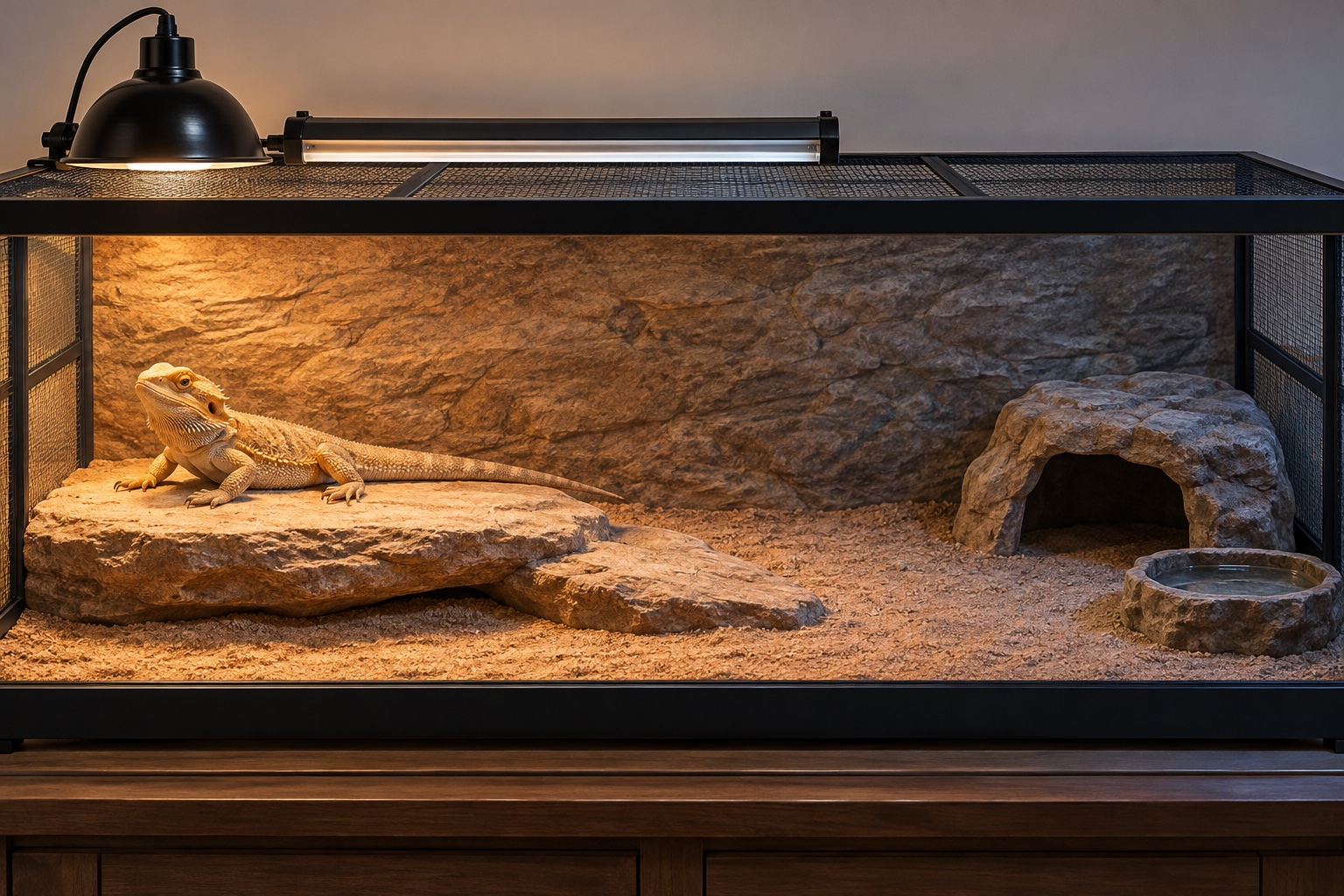
The number on a thermostat is not a measurement of everything beneath the lamp. A stone can be hot while the nearby air is much cooler, and a reading taken at floor level says little about UV exposure at the back of a dragon sitting on a raised platform. Before changing a bulb, I would write down exactly what each instrument is measuring and where.
For a central bearded dragon, Pogona vitticeps, a basking area needs more than a warm rock. It needs a stable surface, an appropriate overhead heat source, overlapping UVB, and an easy route into cooler shade. This guide explains how to assemble and check that area for an otherwise healthy dragon. A young, unwell, or mobility-impaired animal needs a plan adapted with a reptile veterinarian.
Plan the cool end before adding more heat
Choose one end of a suitably spacious, ventilated enclosure for basking. Keep a shaded retreat at the other end, with a clear walking route between them. The animal must be able to move its whole body out of the heated, brightly lit area without climbing over equipment or getting trapped behind furniture.
The RSPCA gives 120 × 60 × 60 cm as a minimum enclosure for one adult, with more space beneficial where available. That is a starting enclosure size, not a promise that any lamp will work safely inside it. Room temperature, ventilation, construction, and the position of furnishings all affect the result. A sunny window or radiator can heat the cool end independently of the thermostat.
Place the enclosure where those outside influences are manageable. If increasing lamp output heats the entire enclosure, do not keep increasing it to chase one surface reading. Review the layout, enclosure size, ventilation, and equipment with an experienced reptile professional. A basking spot is useful only when the dragon also has a genuine escape from it.
Use a platform that cannot shift
Select a broad, stable, cleanable surface that supports the dragon comfortably, with secure footing and a straightforward way down. A suitable natural stone slab or purpose-made reptile platform can work. Avoid sharp edges, loose stacks, and a narrow summit that warms only a small part of the body.
Test stability before the animal enters. Heavy furnishings need secure support rather than being balanced on loose substrate that can be dug away. Consider what happens if the dragon pushes underneath or climbs onto the highest edge. Remove pinch points and gaps where a foot, head, or tail could become caught.
Keep the highest reachable position within the lamp manufacturer's safety limits. Measure from the animal's likely position, not just the empty platform: its back and head will be closer to the lamp than the stone is. Adding a branch later can create a new, much closer basking position even if the original platform has not moved.
Do not use an electrically heated rock as the basking surface. Provide heat from suitable protected overhead equipment and check the stone's temperature independently. Wash hands after handling the reptile or enclosure furnishings, and keep cleaning equipment separate from food preparation areas.
Fit the lamps as a system
For a typical setup, a suitable white-light basking lamp supplies daytime heat and an appropriate linear reptile UVB lamp supplies ultraviolet exposure. Arrange their useful areas to overlap at the basking platform, while preserving shade elsewhere. A normal household LED or a lamp described only as “full spectrum” is not evidence of adequate UVB.
Use fixtures rated for the lamps, secure mountings, and protection that prevents the dragon touching hot components. Keep cables away from the animal, water, and hot fittings. Follow the instructions for the enclosure, bulb, fixture, and guard together. A clamp that slips can change both burn risk and UV exposure.
A compatible dimming thermostat can regulate a dimmable basking heat lamp. Confirm compatibility rather than connecting every lamp type to a dimmer; some combined heat-and-UV lamps require a different arrangement. Position and secure the thermostat probe as instructed for the heating setup, where the dragon cannot move it or cover it. Independent thermometers are still needed to check the outcome.
Glass and ordinary clear plastic can block useful UVB. Mesh and guards can also reduce it, with the effect depending on their construction. Do not copy a distance from a photograph of a different lamp above a different lid. Use the exact lamp-and-reflector guidance, then check the installed arrangement. Manufacturer minimum distances remain relevant even when you are adjusting the platform to improve a reading.
Measure the surface and the air separately
Let the complete setup run to stable daytime conditions before checking it. Measure again later in the day, particularly if the room gets warmer in the afternoon. Test with the normal doors, ventilation, lid, and lights in their operating positions; briefly open access only as needed to take a direct reading safely.
An infrared thermometer measures a surface, not the surrounding air. Aim at the actual basking material through open access rather than through glass. Follow the instrument's distance-to-spot guidance: the sampled area must fit within the target. Reflective surfaces can give misleading readings, and the small laser marker, if fitted, does not show the full area being measured. Keep any laser away from eyes and animals.
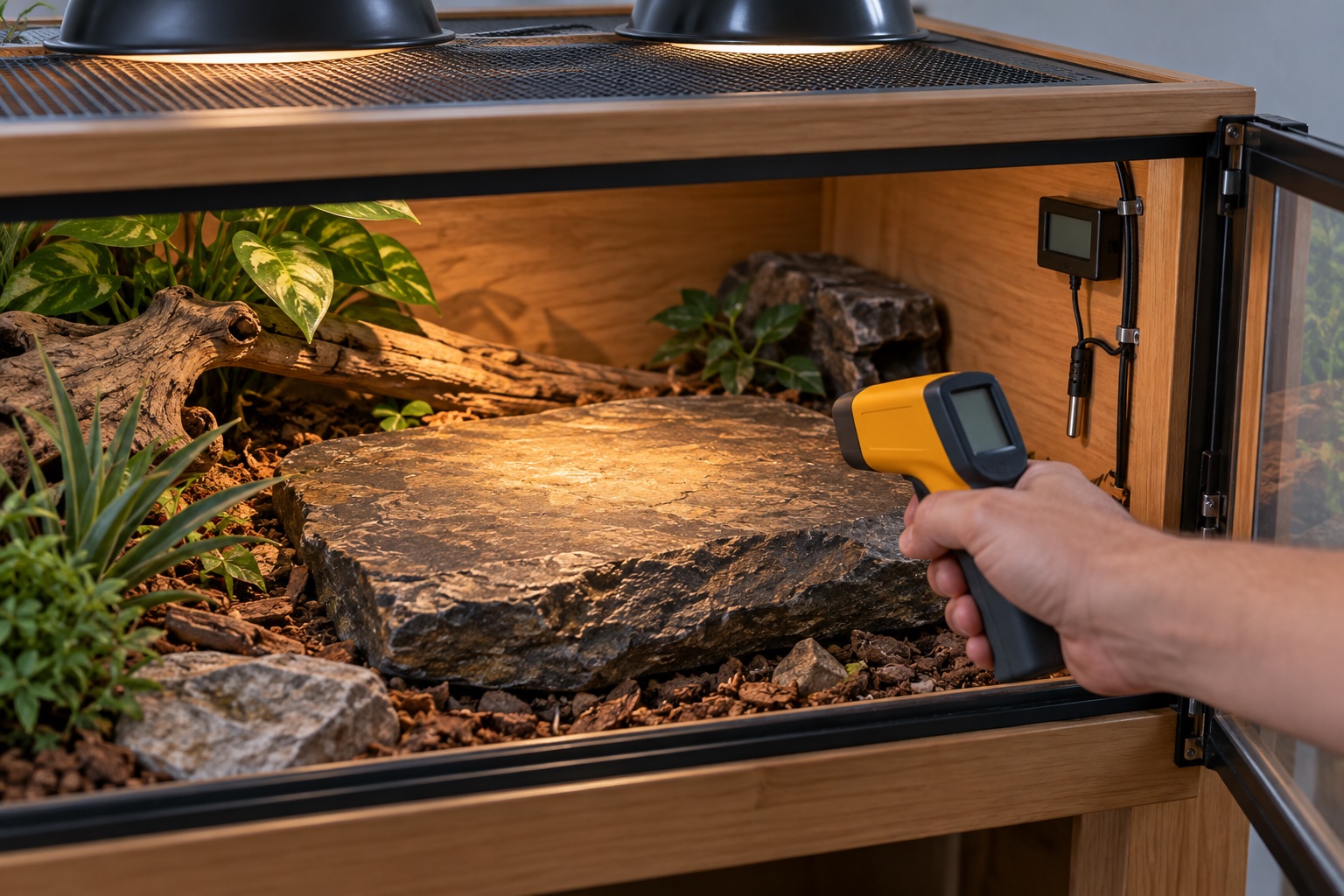
Scan the centre, edges, and any higher reachable surfaces to find hot patches. Use a separate digital thermometer probe to measure air at animal level in the cool end; a probe exposed to direct lamp radiation may not represent shaded air temperature. A thermostat display, an infrared reading, and a shaded-air reading are different measurements and should be recorded that way.
Published care sheets use different basking ranges and do not always identify the same measuring surface. The RSPCA describes a 38–42°C basking zone, while SPCA New Zealand gives about 40–45°C. For an initial surface check in a standard healthy central bearded dragon setup, around 40–42°C sits within those ranges; confirm the intended surface target with your reptile veterinarian rather than treating this overlap as a universal prescription. The RSPCA's shaded cool-end guidance is 22–26°C. Do not try to heat all the air to the basking-surface target.
Check UV at the animal's height
Temperature does not tell you how much UV reaches the dragon. Use a suitable reptile UV Index meter to check at the height of the animal's back in its normal basking position, following meter instructions. Also check the nearest accessible climbing position and the shaded retreat. Take these measurements without putting the dragon under your hands or tools.
The RSPCA recommends a basking UVI of 3–5, falling to zero in shade, for typical bearded dragons. Individual needs can differ, particularly with unusual pigmentation or medical problems; ask a reptile veterinarian about those animals. A lamp's percentage rating is not a UVI reading at the platform.
Record the lamp model, reflector, installation date, mesh or guard, distance to the animal, and measured UVI. Recheck after changing a bulb, moving the platform, altering a guard, or replacing the lid. A brightly glowing tube can still have inadequate UV output. Follow its replacement guidance and monitor output rather than using visible brightness as the test.
If you cannot obtain a suitable meter, ask a reptile veterinarian or experienced supplier for help checking the actual installation. In the meantime, use the manufacturer's current instructions for that exact combination rather than an online distance chart for another fixture. Do not lower a lamp experimentally until it “looks brighter.”
Make one adjustment, then repeat the checks
If the stone is too hot but the cool end is suitable, review the heat lamp's regulated output and placement. If it is too cool, check the measurement method, thermostat probe, lamp suitability, and room conditions before buying a stronger bulb. If you change platform height, you must check UV exposure again as well as heat.
A useful record might read: “centre surface, edge surface, shaded cool-end air, basking UVI, room temperature,” followed by the time. That is more useful for troubleshooting than “tank temperature 40.” Keep the same measuring points so a later change is meaningful.
Set an appropriate daytime lighting period and darkness at night. Do not leave a bright basking lamp on overnight to preserve daytime temperatures. Whether additional non-light-emitting night heat is needed depends on the overnight readings and the animal's husbandry plan. Any such equipment needs its own suitable control and protection.
Watch use of the area without forcing it
Once checks are satisfactory, let the dragon choose when to bask and when to retreat. Do not repeatedly place it back under the lamp because you think it has spent too little time there. Observe ordinary activity, access to shade, appetite, posture, and whether it can climb down easily.
A dragon may gape while basking, but an open mouth is not a reliable thermometer. Persistent open-mouth breathing away from basking, visible breathing effort, discharge, weakness, tremors, or difficulty moving needs veterinary attention. Do not respond to those signs by simply adding more heat or supplements.
If there is a suspected burn, collapse, or severe overheating, prevent further exposure safely and contact a reptile veterinarian urgently. Avoid ice, improvised cold baths, and home medication. Bring your equipment details and recent measurements. Recheck the basking surface and cool end daily, and repeat the full assessment whenever furnishings, lamps, or seasonal room conditions change.
Sources and further reading
- RSPCA: Bearded dragon environment, heating and UVB guidance
- SPCA New Zealand: Caring for bearded dragons
- University of Queensland VETS: Bearded dragon care and heating safety
- Dr Frances Baines, LafeberVet: UVB Lighting for Reptiles
- Arcadia Reptile: Full-sun basker lighting guidance for its products
- ThermoWorks: Limitations of infrared thermometers
- VCA Animal Hospitals: Bearded dragon diseases and warning signs
Editorial note: The illustrations on this page were generated for DailyTrail to show the setups described. They are not photographs of the author's animals or scale diagrams for lamp installation. This article provides general husbandry information and does not replace advice from a veterinarian familiar with reptiles.