
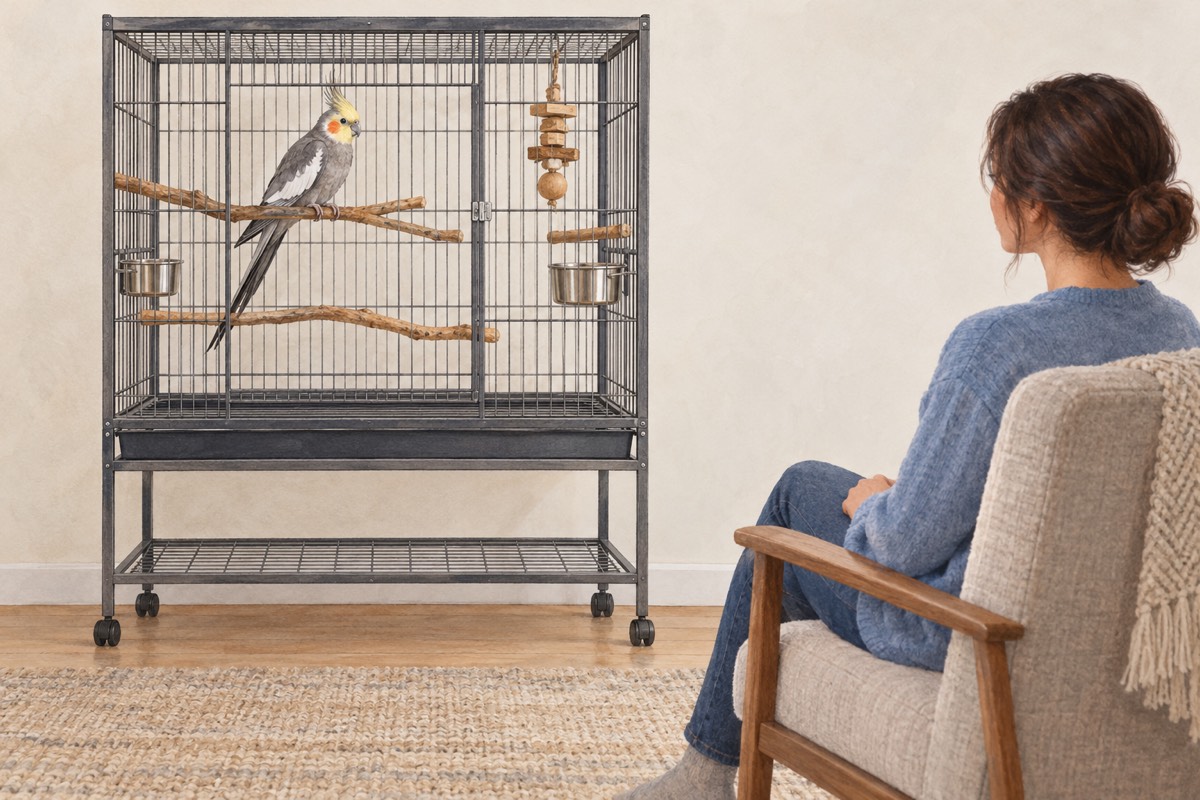
A cockatiel that retreats to the far perch as you change its water may need more distance from your hand. There is no need to turn that moment into a lesson in stepping up. I would finish the necessary care calmly, move away, and notice whether the bird returns to eating or exploring once it has more space.
Arriving in a new home changes the sounds, people, cage position, and daily routine at once. A previously friendly bird may hesitate, while a very still bird may be frightened rather than relaxed. The first job is to make food, water, rest, and ordinary care predictable. Physical contact can develop from there, at the bird's pace.
Set up the room before asking for attention
Choose a stable cage position in a quiet part of the home where the bird can see people approaching. Avoid a busy doorway, direct draughts, and a window that puts the cage in strong sun. A solid wall behind part of the cage can reduce activity on one side, but the bird still needs good ventilation and space. Quiet should mean a manageable environment, not being left alone in a dark room all day.
Keep the cage out of the kitchen and away from smoke, aerosols, scented diffusers, and cooking fumes. Keep cats, dogs, ferrets, and other animals out of the room. Visitors do not need to gather around the cage to say hello on arrival. One calm person doing the essential care is easier to follow than several people repeatedly approaching from different directions.
Inside, leave clear space for movement between suitable perches and accessible food and water cups. The bird should be able to stretch its wings and turn without striking toys or its tail. Start with a few appropriate furnishings rather than filling every gap. Introduce unfamiliar toys gradually if the bird avoids them; moving every perch each morning makes the cage another changing environment to work out.
Make eating easy to confirm
Ask the previous carer what the cockatiel actually eats, how food and water were offered, and whether it feeds independently. Bring a supply of familiar food. Do not combine the move with a sudden switch to a completely new diet or remove familiar food to make the bird hungry enough to accept something from your hand.
Familiar food is a bridge through the move, not a declaration that the previous diet is balanced. Arrange an avian veterinary check and discuss any dietary transition there. Our parrot feeding guide explains why a full bowl does not prove adequate intake and why changes need to suit the species. An unweaned bird needs experienced care; learning syringe-feeding from an article is not a safe way to manage a bird that is not feeding itself.
Check the bowls rather than judging by appearances from across the room. Seed husks can sit on top of remaining food and make a dish look fuller than it is. Look for actual eating, check that water can be reached from a secure perch, and keep the dishes clean. If the bird only approaches food when you leave, observe from farther away or briefly from outside the doorway without making repeated close visits.
Line the tray with plain paper so droppings are visible. Record eating, drinking when observed, droppings, activity, and any concerns in a few words. A note such as “ate from familiar cup after I stepped away” is more useful than “still shy.” If you cannot establish that a newly arrived bird is eating, call an avian veterinarian promptly for guidance rather than assuming it will eat when hungry enough.
Find a distance at which ordinary behaviour continues
Sit or stand a little way from the cage, slightly side-on, and speak softly. Watch what changes when you approach. A bird that stops eating, leans away, retreats, hisses, or begins moving rapidly along the bars is asking for a less intense approach. Step back and reduce the demand. Do not stay close until it “gets used to it.”
Look at the whole situation rather than using crest position as a single mood gauge. Cockatiels move their crests for several reasons. Where the bird is going, whether it continues feeding, and what happens when you move away provide better context than a photograph of an upright crest.
As a practical starting point, make visits brief enough that you can leave before the bird becomes unsettled. There is no required number of minutes or days. If it can continue eating or moving normally while you sit nearby, repeat that easy experience before moving closer. Some birds progress quickly; others need smaller steps because their previous handling or confidence differs.
Let an invitation remain optional
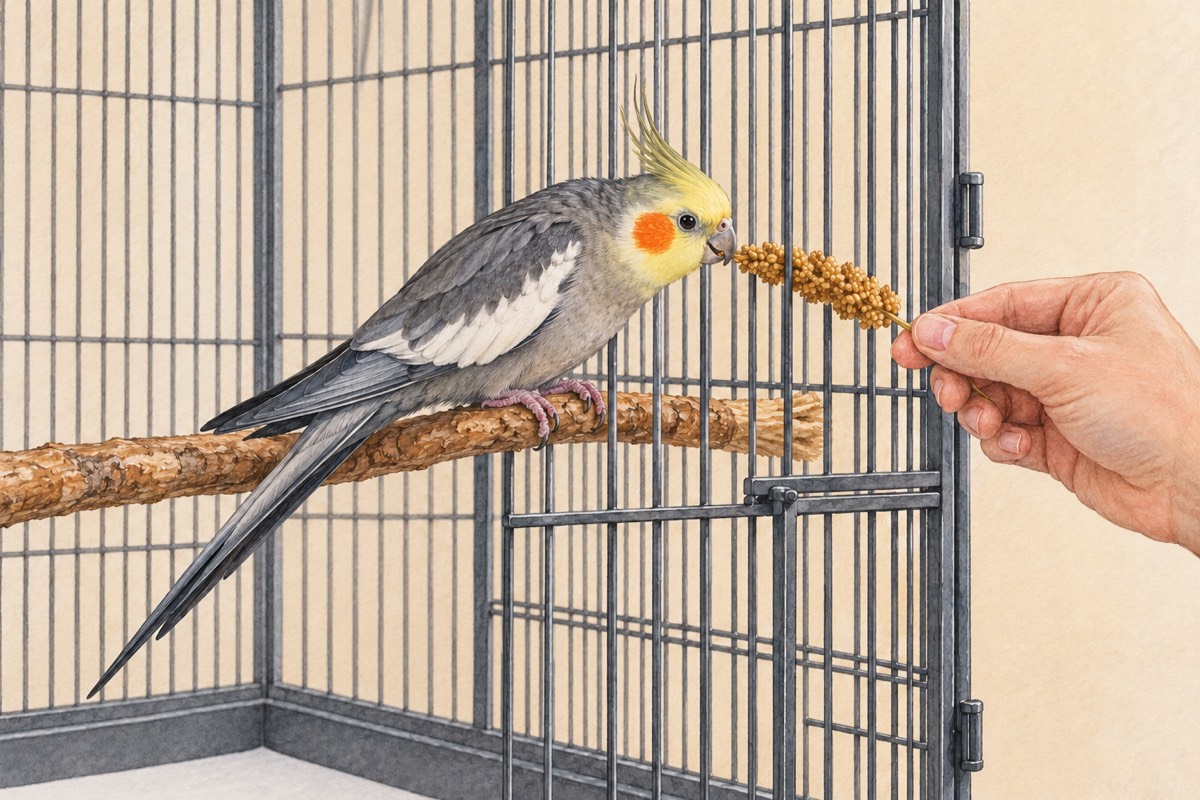
Once the cockatiel is eating reliably and appears comfortable with your presence, you can offer a small amount of a familiar, bird-appropriate food. A short piece of millet spray held outside the closed cage can keep fingers farther away. Position it near a comfortable perch without poking through the bars or trapping the bird between your hand and a wall.
Wait for a voluntary approach. If the bird stays away, remove the offer calmly and try an easier interaction another time. Keep normal meals available. Taking food once does not mean the bird is ready to be touched, picked up, or carried across the room. You can reward a small approach without immediately asking for more.
Positive reinforcement means the bird gains something it values for a behaviour you want to encourage. For example, approaching the feeding spot can lead to a small reward, then the interaction ends while it remains comfortable. Do not shout, tap the cage, spray water as punishment, or push a finger against its chest to force a step-up. If biting occurs, review how close and how fast you approached rather than treating the bite as a challenge to win.
Make necessary care predictable
Food changes, fresh water, and tray cleaning still have to happen while trust develops. Prepare supplies before opening a service door. Approach visibly, use the same quiet verbal cue, and move directly to the task. Keep your hand away from the bird's body and avoid pursuing it around the cage with the bowl.
If cleaning routinely causes frantic flapping, review the layout and your approach. External-access cups or an easier tray arrangement may reduce intrusion, provided doors and fittings remain secure. Move slowly, but do not repeatedly pause with a hand looming above the bird. Finish essential care and give it room to recover. Ask an avian vet or qualified bird behaviour professional for help if ordinary maintenance cannot be done without major distress.
Keep a consistent evening routine with a quiet opportunity for uninterrupted sleep. Do not keep waking the bird to check whether it is becoming friendlier. A cage cover is not a punishment or a way to suppress daytime fear; any use must preserve ventilation and suit the bird's response.
Plan the first outing before opening the door
Out-of-cage activity is part of ongoing care, but the first release should be planned for a room the bird can use safely. Close and secure windows and external doors, turn ceiling fans off, make glass and mirrors visible, remove open water and hot surfaces, and keep other animals out. Arrange a safe landing place near the cage and leave time for a calm return.
Consider how the cockatiel will go back before opening the cage. A bird does not have to accept a hand immediately, but you need a workable return plan suited to its skills and the room. If you are uncertain, get advice on voluntary perch or target training first. Do not chase it to exhaustion, clip its wings simply to make it dependent, or withhold meals as a shortcut. Flight ability, health, previous experience, and the room all affect the next step.
Do not label illness as settling-in behaviour
Arrange a new-bird examination with an avian veterinarian soon after arrival. If other birds already live in the home, discuss quarantine and testing before contact; a new cage beside the resident bird is not quarantine. Use separate equipment and follow the veterinarian's instructions about rooms, hygiene, and the timing of introductions.
A frightened bird can be quiet, but so can a sick one. Poor appetite, markedly fewer droppings, persistent fluffed posture with reduced activity, weakness, or repeated sleeping when normally alert deserve prompt veterinary advice. Laboured or open-mouth breathing at rest, tail movement accompanying each breath, collapse, bleeding, or inability to perch require urgent care. Do not wait for a bonding timetable to expire.
For a veterinary call, have the arrival date, previous diet, observations of intake and droppings, and any video taken without disturbing the bird ready. Avoid force-feeding, giving medication, or attempting restraint without professional guidance. The useful early milestone is a cockatiel that can eat, rest, and choose to approach in a predictable home. Being held is only one possible later step.
Sources and further reading
- VCA Animal Hospitals: Taming, training, and talking to birds
- RSPCA Australia: How should I handle my bird?
- World Parrot Trust: The power of positive reinforcement
- VCA Animal Hospitals: Housing small birds
- VCA Animal Hospitals: Introducing a new pet bird
- VCA Animal Hospitals: Recognizing signs of illness in pet birds
- VCA Animal Hospitals: Abnormal droppings in birds
Editorial note: The illustrations on this page were generated for DailyTrail to show the setups described. They are not photographs of the author's animals. This article provides general husbandry information and does not replace advice from a veterinarian familiar with birds.
[…] approach, put the project aside and first work on predictable care and comfortable distance. Our guide to helping a cockatiel settle into a new home covers that earlier […]