
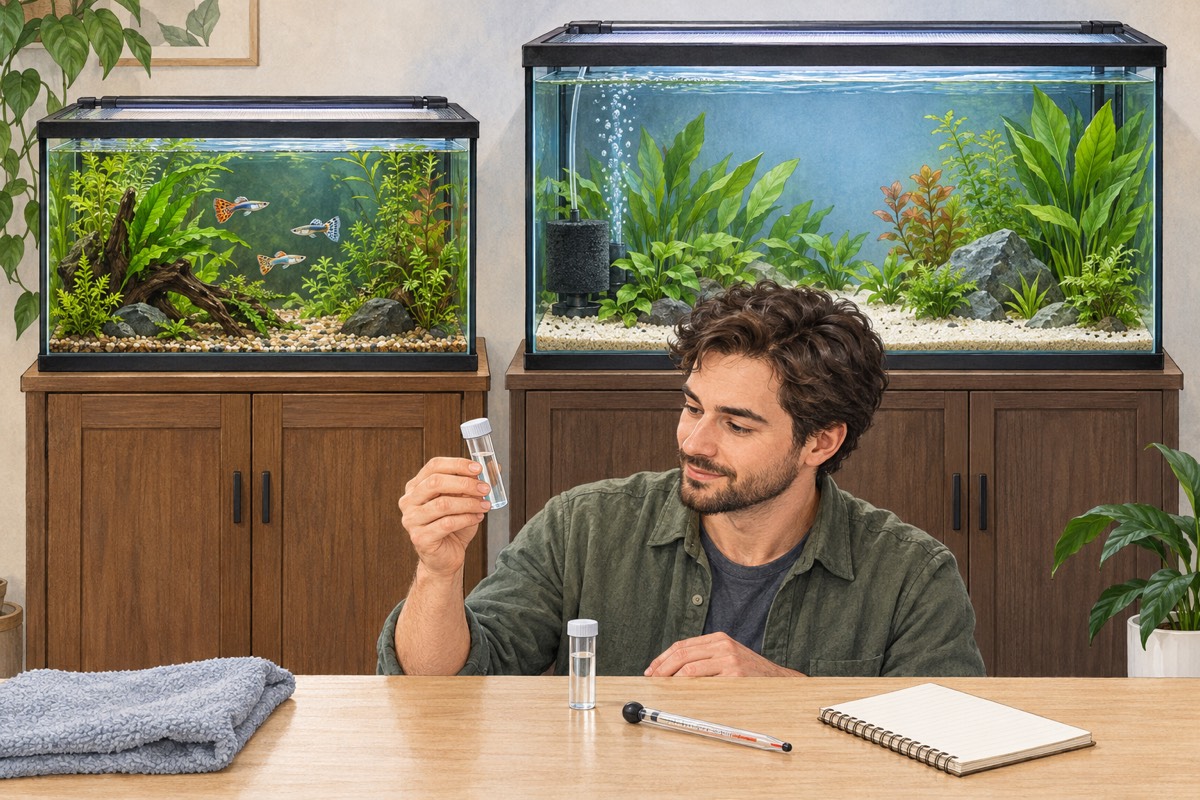
The first fish should not be in a bucket while you are still deciding where the filter goes. For a planned tank upgrade, I would prepare and test the destination first, keep the existing aquarium working, and catch the fish only when the next steps are ready. That leaves fewer decisions to make while the animals are confined in a small volume of water.
This guide covers moving healthy freshwater aquarium fish between tanks in the same home. Marine fish, sensitive invertebrates, long-distance shipments, and emergency moves from contaminated water need a plan specific to the animals and circumstances. A larger tank can improve the setup, but extra litres alone do not supply biological filtration or make different water chemistry safe.
Decide how the new tank will handle waste
A working biofilter contains microorganisms that process ammonia and nitrite. Much of that useful community lives on filter media and other surfaces. Carrying over buckets of old water is not the same as transferring an established filter. Clear water and a running pump tell you little about whether the system can handle the fish's waste.
There are two common approaches to a planned upgrade. One is to establish the destination tank's own biological filter before moving fish, using a fishless cycling method and testing its progress. Follow the aquarium maturation product's directions and obtain advice if the results do not make sense. Zero ammonia in a newly filled tank that has had no ammonia source does not prove that it is cycled. Do not use a fixed number of days as the readiness test.
The other approach is to move an established, appropriate filter with its existing healthy fish population. This can preserve much of the filtration capacity, but moving a small piece of old sponge into an otherwise new filter is not a guarantee. Ask an experienced aquatics professional to help plan this if you cannot keep filtration working through the move or if the old filter will not fit the new system.
Keep stocking and feeding conservative after either approach. Moving the existing fish, replacing all the media, and adding new fish on the same day combines several changes you cannot easily separate if water quality deteriorates. If fish remain in the old tank, they still need adequate filtration there; do not strip it of its working media to equip the new one.
Prepare the destination before catching anything
Set the tank on an appropriate, level support and check for leaks. Fit the filter, suitable cover, and any species-appropriate heating and aeration. Arrange stable furnishings with open swimming routes and refuge spaces. Keep electrical connections dry and follow the equipment manufacturer's instructions, including when a heater may safely be powered on or removed from water.
Use water suitable for the species and treat tap water with an aquarium conditioner that addresses chlorine and chloramine as applicable to your supply. Follow the product instructions for the water volume and method being used. Let equipment run so you can confirm its operation and temperature stability. This equipment check is separate from establishing the biofilter.
Test both aquariums and record temperature, pH, ammonia, nitrite, and nitrate. Check general and carbonate hardness where relevant to your species and water source. For an ordinary freshwater move, ammonia and nitrite should be undetectable on the appropriate aquarium tests; the new tank must also have a credible filtration plan. Compare the readings rather than assuming two tanks filled from the same tap are identical.
A large difference in pH or hardness needs investigation before a routine transfer. An old, poorly maintained aquarium can have low pH and accumulated ammonia; suddenly raising pH can increase ammonia toxicity. Do not fix that situation by moving fish through a generic acclimation routine or repeatedly adding pH-adjusting chemicals. Seek advice from a fish-experienced veterinarian or knowledgeable aquatics professional.
Keep established media working, not just wet
If moving the existing filter, keep it running on the original tank until the transfer equipment and destination are ready. Plan to restart it in the new aquarium promptly. Protect biological media from drying, untreated tap water, detergent, and temperature extremes. For any holding period, maintain suitable water and oxygenation rather than leaving media sealed in stagnant water indefinitely.
If a sponge is clogged, gently clear debris with water removed from the healthy aquarium. The RSPCA and OATA advise against rinsing established media under the tap. Avoid an unnecessary deep clean at the same time as the move. Make sure media sits correctly in the filter so water passes through it, then check flow after restarting.
Only use donor media from a healthy, disease-free system. Equipment and media can transfer unwanted organisms as well as useful microbes. A move involving suspected disease is not the same project as a routine upgrade, and new purchases still need an appropriate quarantine plan.
Catch once, with the route already clear
Prepare clean, aquarium-only containers with no soap or chemical residue, an appropriate net or smooth transfer vessel, and a secure ventilated cover where needed to prevent jumping. If fish must wait, the holding container needs suitable temperature and oxygenation for the species, numbers, and duration. Keep it out of direct sun and away from household traffic. A bucket is a temporary holding arrangement, not an unfiltered replacement aquarium.
Dim the aquarium lights. Move only the furnishings necessary to make capture calm and controlled, taking care not to trap fish or destabilise decor. Guide rather than repeatedly chase. Keep handling time short and avoid touching the body with dry hands. Spiny or easily entangled species may need a different capture method; get species-specific advice before using a net.
Do not carry a filled aquarium with fish inside. Count the fish as you transfer them, and check refuges before emptying or cleaning the old tank. Leave a safe fallback available until the move and equipment checks are complete.
Match the water before release
For a short move between your own healthy tanks, compare conditions before capture and minimise the differences in the destination. If temperature and chemistry are already suitably matched, there is no benefit in leaving fish in a small container simply to complete an arbitrary waiting period. If differences remain, choose an acclimation method appropriate to the species with professional guidance.
Floating a sealed bag can equalise temperature; it does not equalise pH or hardness. Gradual mixing or drip acclimation can help with some transfers, but duration and method depend on the fish, water differences, and condition of the holding water. Monitor the animals throughout. This article's same-home process should not be used as a long acclimation recipe for fish that have spent hours in shipping water.
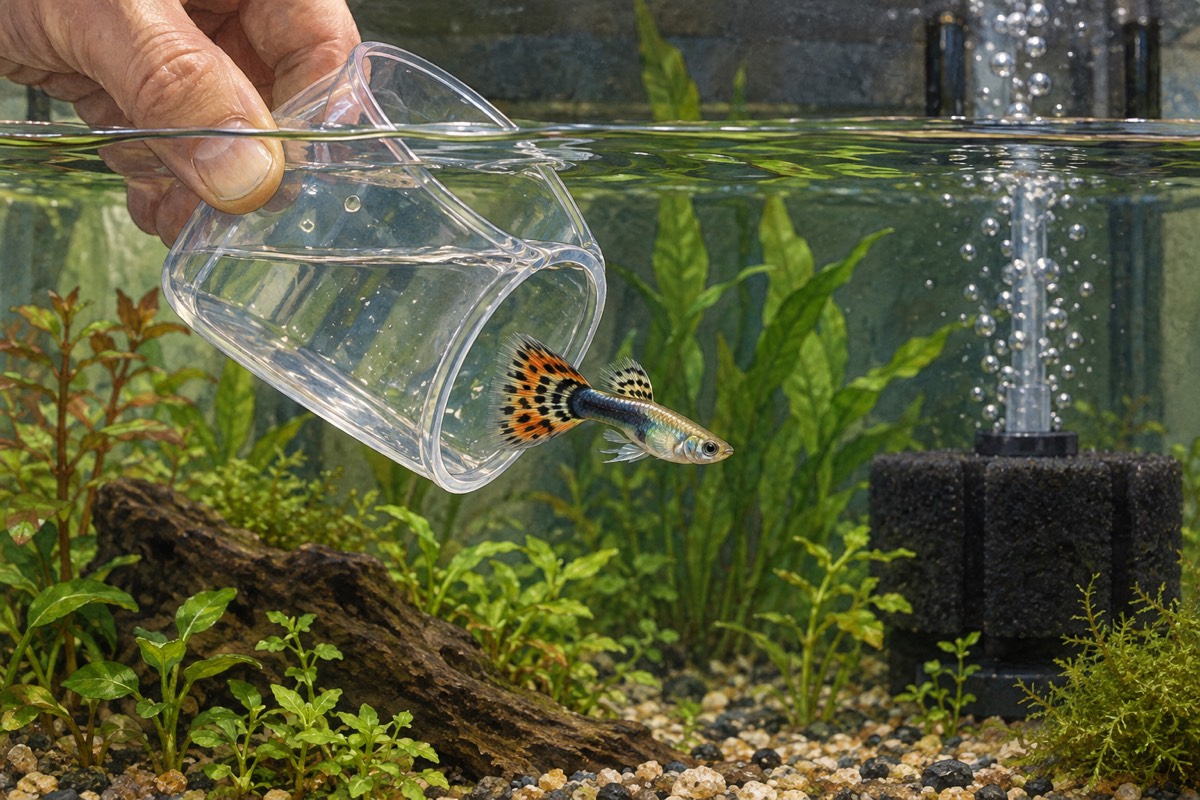
Transfer gently using a suitable net or vessel. For a small fish that can be safely moved in a smooth cup between your own healthy tanks, a submerged release can avoid lifting it into air; a small amount of that known water will enter the destination. Do not pour in a whole holding bucket. With shop or transport water, minimise its entry into the aquarium and follow the supplier's species-specific instructions. Keep the lid secure after release and allow refuge space without repeatedly rearranging the tank to make every fish visible.
Follow the move with tests, not just a head count
Check filter flow, temperature, and aeration immediately after setup. Observe breathing, balance, swimming, hiding, and interactions. Some caution is expected in a changed layout, but surface gasping, rapid gill movement, loss of balance, or widespread distress needs immediate attention. Test water and inspect equipment while arranging qualified help; do not assume the fish are merely settling in.
Test ammonia and nitrite daily during the initial period after the move, and continue close checks until readings and behaviour are stable. Record results alongside temperature, feeding, and any water changes. An established filter reduces risk but does not remove the need to monitor it after disturbance. Avoid extra food as a welcome treat and remove leftovers.
If ammonia or nitrite becomes detectable, act promptly: check filtration and oxygenation, use appropriately conditioned, temperature-matched water for partial changes, and get advice on the amount and frequency for the actual readings and fish. Keep checking after intervention. Do not add salt, medication, or a collection of water treatments without a reason specific to the problem.
For goldfish keepers, our goldfish water-change guide explains preparing replacement water and cleaning without unnecessarily disrupting the filter. If a fish is injured, cannot maintain balance, remains distressed despite corrected conditions, or several fish deteriorate, contact a fish-experienced veterinarian. Have the before-and-after water readings, equipment details, and transfer timeline ready.
Sources and further reading
- RSPCA: Aquarium environment, filtration and cycling
- OATA: Setting up and maintaining a freshwater aquarium
- OATA: Understanding and testing freshwater water quality
- Merck Veterinary Manual: Management of aquarium fish
- Merck Veterinary Manual: Environmental diseases in aquatic systems
- Merck Veterinary Manual: Routine health care of fish
Editorial note: The illustrations on this page were generated for DailyTrail to show the setups described. They are not photographs of the author's animals. This article provides general husbandry information and does not replace advice from a veterinarian familiar with fish.
[…] the tank itself is unsuitable and a planned upgrade is needed, our guide to moving aquarium fish to a new tank explains preparing filtration and comparing water conditions before capture. It is not an emergency […]
[…] an aquarium upgrade rather than a local cleaning task, our guide to preparing a new tank before moving aquarium fish explains why established filtration matters. Its fish-transfer method is not a shrimp-acclimation […]