
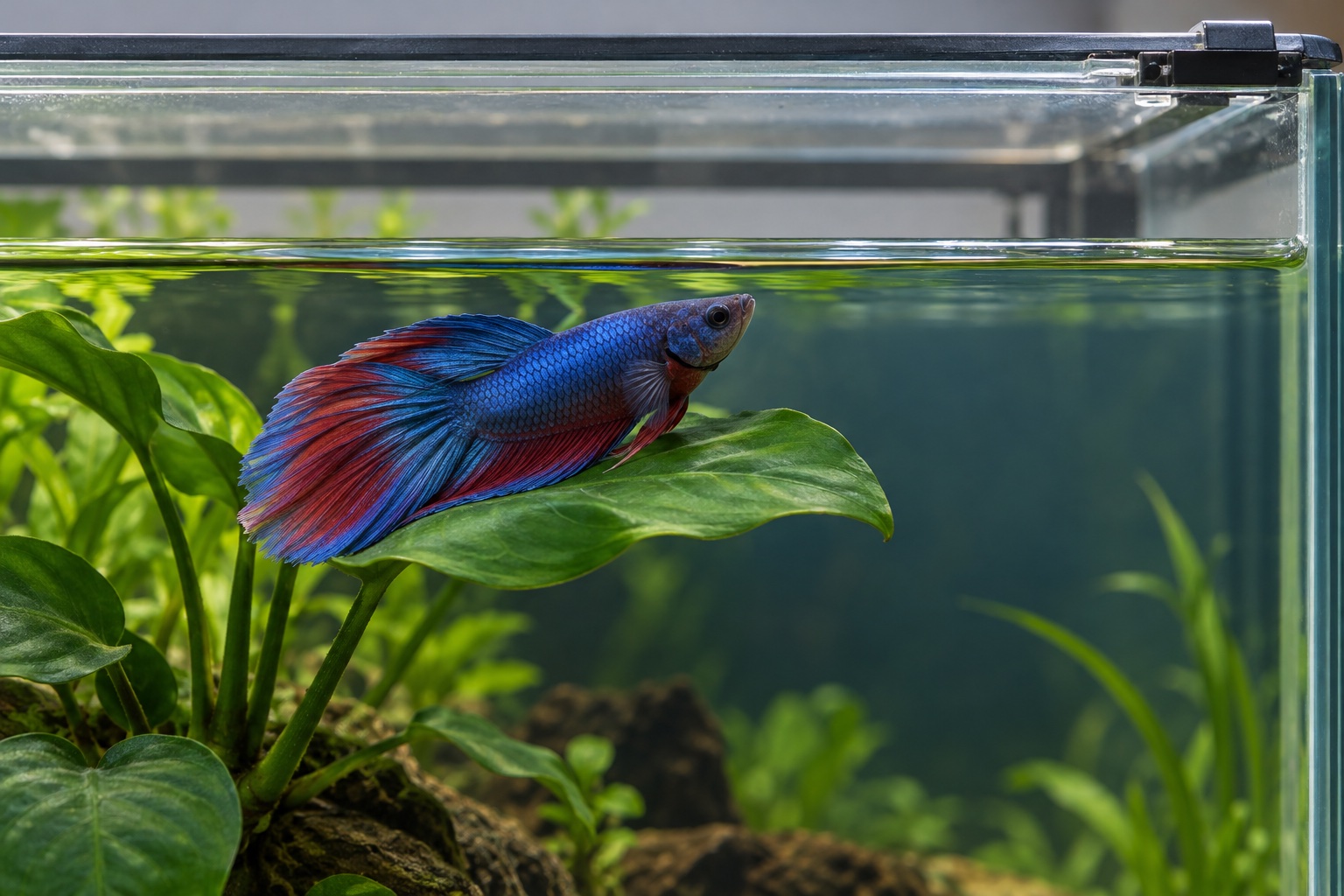
Before buying a leaf hammock, watch where your betta pauses. There may already be a broad plant leaf it returns to, a quiet corner away from the filter outlet, or a place where it struggles to stay still. Those observations help decide whether the tank needs another resting surface, a change in flow, or a water-quality check before you add anything.
I would judge a resting spot by the route around it: can the fish settle with its body supported, leave without squeezing through a gap, and reach the air above? A leaf that looks attractive against the front glass may fail that test if the filter pushes the fish off it.
This guide concerns the common domestic betta, Betta splendens, in an established freshwater aquarium. A new difficulty reaching the surface is a health concern, not simply a reason to buy a higher perch.
Keep a clear route to air
Bettas take air at the surface using their labyrinth organ. A broad resting surface near the top can shorten that journey, but the fish still needs well-maintained water and effective filtration. Air breathing does not make ammonia, temperature swings, or poor oxygenation harmless.
Leave an air space between the water and a secure, appropriately fitted lid. Bettas can jump; removing the cover is not a sensible way to provide access. Keep cable openings secure without defeating the ventilation and equipment arrangements specified for the aquarium. Floating plants should leave open areas where the fish can surface easily.
The resting leaf itself belongs underwater. Position it so the fish remains submerged while resting and has room to rise naturally. There is no need to balance the fish at the waterline or make it slide across an exposed surface. Check from the side, because a top-down view can hide how little water remains over the leaf.
Choose a support you can inspect
A healthy broad-leaved aquarium plant can provide both cover and a place to pause. Select a plant suited to your tank's lighting and growing conditions, with help from a knowledgeable aquarium supplier. The particular leaf must be stable enough to support the fish rather than constantly folding or whipping in the flow. Follow planting instructions for the species; not every plant should have its rhizome buried in gravel.
A purpose-made aquarium leaf hammock is another option. Look for a smooth, gently shaped surface large enough for the fish's body, a secure attachment, and no sharp moulding seams. Examine the underside and stem as well as the visible upper surface. Reject cracked plastic, rough edges, exposed wire, loose coatings, or components that can detach. An aquarium label is a starting point for inspection, not proof that every edge is safe.
Soft artificial aquarium plants can offer resting cover, but inspect their bases and internal supports. Do not substitute craft foliage, household suction hooks, adhesive-backed shelves, or an unknown piece of plastic. A small saving is difficult to justify when you cannot establish what will remain submerged in the water.
I would start with one support and keep other familiar cover in place. Filling the entire upper tank with furniture makes it harder to check access and gives the fish fewer open swimming routes.
Place it in the quiet part of the tank
Watch the water movement before attaching the support. A suitable location lets the betta remain in place without continuous hard swimming and allows a straightforward approach from open water. Keep the resting area away from a forceful outlet, the filter intake, and the heater. Do not make a narrow slot between the leaf and equipment that the fish could enter and struggle to leave.
A fully submerged position a few centimetres below the surface is a practical starting point, rather than a universal measurement. Adjust for the fish's body size, the shape of the support, and the actual water level. There should be room for its body and fins above the leaf, with a clear route upwards and sideways. Long-finned fish particularly need an arrangement that does not snag or fold their fins against the glass.
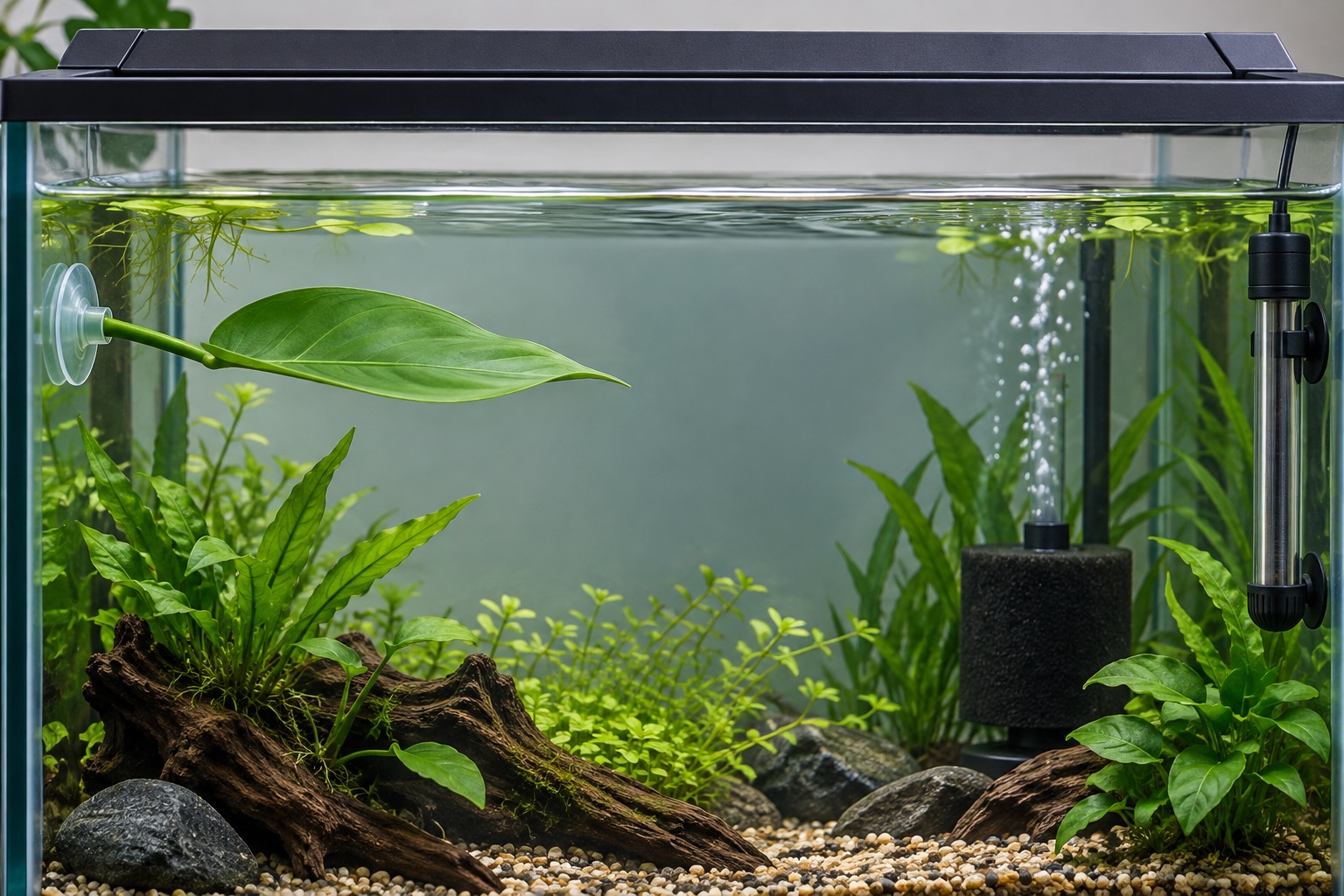
For a suction-mounted support, clean the attachment area with aquarium-only equipment, then fit and test it according to the manufacturer's instructions. Check that it holds before leaving the fish to investigate. Keep hands free of soap, lotion, and other residues, and follow electrical equipment safety instructions before working in the tank.
Avoid netting the betta onto the leaf or chasing it into that corner. Leave the support available and step back. It may choose another resting place, and that alone does not mean the installation has failed.
Reduce forceful flow without switching off filtration
If the fish is swept sideways or has to keep fighting the current at the resting spot, change the placement first. Where appropriate, use the filter's approved flow adjustment or a suitable diffuser recommended for that equipment. Check that the change still provides effective circulation and surface movement elsewhere in the aquarium.
Do not turn the filter off each night so the betta can sleep, obstruct an intake with improvised material, or let plants smother the filter. A quiet refuge and a working biofilter should coexist. If the only calm place is directly behind the heater or squeezed beside the filter, review the overall layout and equipment rather than adding more ornaments to that gap.
Confirm temperature with a thermometer rather than judging it by touch. The RSPCA Australia guidance gives 24–26°C for domestic bettas. Use an appropriate thermostatically controlled aquarium heater where needed and check stability; a warm room during the afternoon does not establish what happens overnight. This is routine care guidance, not a recommendation to raise the temperature as treatment for an unwell fish.
Observe a whole pattern, not one still moment
A betta may rest on plants, furnishings, or the bottom. What matters is how that pause fits its usual behaviour. Look for ordinary swimming between rests, balance and control, normal interest in food, and breathing that has not become noticeably more laboured. The fish does not have to use the new leaf on your schedule.
Take a quiet look after installation and again during the fish's usual active and resting periods. Do not tap the glass, shine a torch repeatedly at night, or offer food every time you want proof that it is awake. Keep a regular light-and-dark cycle and let it rest undisturbed.
A brief note can clarify the next adjustment: “approached leaf, stayed briefly, moved away when outlet flow reached it” suggests a placement issue. “Rested on a plant, later swam normally and ate” describes a different pattern. Record changes without turning each short pause into a diagnosis.
Treat persistent surface distress as a separate problem
Repeated gasping, rapid gill movement, loss of balance, inability to leave the surface, marked lethargy, or a new loss of appetite needs attention. An occasional surface breath is expected in a betta; a clear change from the fish's normal pattern should not be dismissed because it can breathe air.
Check temperature, filter operation, surface movement, and water quality promptly. Use suitable aquarium tests for ammonia, nitrite, nitrate, and pH, and keep the actual readings with the date. Ammonia and nitrite should be undetectable on appropriate tests in a properly functioning established aquarium. Clear-looking water is not a substitute for testing.
If readings are abnormal, seek qualified advice on corrective action, including partial water changes using appropriately conditioned, temperature-matched water. Do not abruptly change pH, empty and sterilise the tank, or replace all established filter media as a response to a fish resting near the surface. Severe breathing difficulty or loss of balance warrants urgent advice from a fish-experienced veterinarian while you check the environment. Avoid adding salt or medication without a reason specific to the problem.
If the tank itself is unsuitable and a planned upgrade is needed, our guide to moving aquarium fish to a new tank explains preparing filtration and comparing water conditions before capture. It is not an emergency treatment plan for a distressed fish.
Recheck the spot when the water level changes
After a water change, look at the leaf from the side again. A support that was comfortably submerged before draining may now sit too close to the surface. Evaporation also alters that distance. Restore the appropriate water level and confirm that the air space beneath the lid remains available.
Inspect suction cups for slipping, artificial leaves for damage, and living leaves for deterioration. Remove decaying material and trapped food during routine maintenance without stripping the aquarium of all cover at once. If a fitting no longer holds reliably, replace it rather than repeatedly pressing a damaged cup back onto the glass.
The useful final check is the fish's route: onto the support, away from it, and up to open air. Keep those routes clear after pruning, cleaning, or moving equipment, even if the betta usually chooses somewhere else to sleep.
Sources and further reading
- RSPCA Australia: Caring for Siamese fighting fish
- RSPCA Queensland: Siamese fighting fish care and environmental enrichment
- The Fish Vet, Dr Richmond Loh: Better betta care
- Merck Veterinary Manual: Environmental diseases in aquatic systems
- Merck Veterinary Manual: Routine health care of fish
Editorial note: The illustrations on this page were generated for DailyTrail to show the setups described. They are not photographs of the author's animals. This article provides general husbandry information and does not replace advice from a veterinarian familiar with fish.