
When an object keeps landing on the floor, I start by reconstructing the sequence rather than assigning the cat a motive. What was on the surface? Where was the cat trying to go? What happened immediately before the paw reached out, and what did the person in the room do next? Those details usually reveal more than the broken cup does.
Knocking an object can provide movement, sound and a reaction. It can also clear a narrow route, turn a quiet evening into human attention, or simply be part of exploring with a paw. The useful question is what the behavior produces in that particular place.
First, identify the payoff
I use a short observation note for repeated incidents: time, location, object, what happened in the previous minute, the cat’s next action and the human response. After several entries, patterns often appear. A cat may push pens only while crossing a crowded desk, tap light objects that roll, or repeat the behavior after learning that it makes someone get up and talk.
- Object play: the item moves, rolls or makes an interesting sound.
- A blocked route: the object occupies a landing place or path between perches.
- Social feedback: knocking reliably starts conversation, chasing, feeding or play.
- Underused hunting behavior: the cat has few safe chances to stalk, chase, pounce and catch.
- Stress or environmental change: the behavior began around a move, schedule change, new animal or conflict over space.
More than one factor can be present. That is why a single deterrent rarely fixes every location.
Treat a sudden change differently
A cat who has always tested small objects with a paw is different from a cat who suddenly misjudges jumps or collides with familiar furniture. Contact a veterinarian if new clumsiness occurs with a head tilt, circling, weakness, unusual pupil appearance, apparent vision trouble, pain, appetite change or altered behavior. Rearranging shelves should not replace a medical assessment in that situation.
Prevent the dangerous outcome before training
Training takes repetition; broken glass, hot liquids and falling electronics create an immediate risk. I first remove fragile, sharp, toxic, hot or heavy objects from any surface the cat can reach. Drinks get lids, medicines and cleaning products go behind closed doors, cords are managed, and unstable televisions or tall furniture are secured according to the manufacturer’s instructions.
There is no dependable rule that moving an item a few inches from an edge makes it safe. A cat can reach, jump onto the surface or push the item in stages. Closed storage is the better choice for anything that could cause injury. Non-slip material or removable museum putty may help with a suitable non-food item, but check the product and surface instructions and keep adhesive material where it cannot be chewed.
If food or dishes draw the cat onto a work surface, the environmental steps in our guide to keeping cats off kitchen counters explain how access, food residue and accidental rewards work together.
Leave a clear route and a legal perch
Before assuming the cat wants an ornament, look at the route through the room. A narrow shelf crowded with frames may sit between two preferred resting places. A desk may be the only way to reach a window. Clear a stable landing area and provide an exit route so the cat does not have to squeeze past objects.
A sturdy perch, cat tree or cleared shelf is useful only when it is stable and placed where the cat actually wants to observe the room. Our indoor cat owner’s manual covers vertical space, separated resources and resting choices in more detail.
Give paws an appropriate target
The goal is to provide the movement and feedback the cat was seeking without putting household objects at risk. Suitable options include a sturdy track toy, a large ball that cannot be swallowed, a food puzzle matched to the cat’s ability, or supervised wand play. Check toys for loose pieces and put away string, ribbon and wand toys after the session.
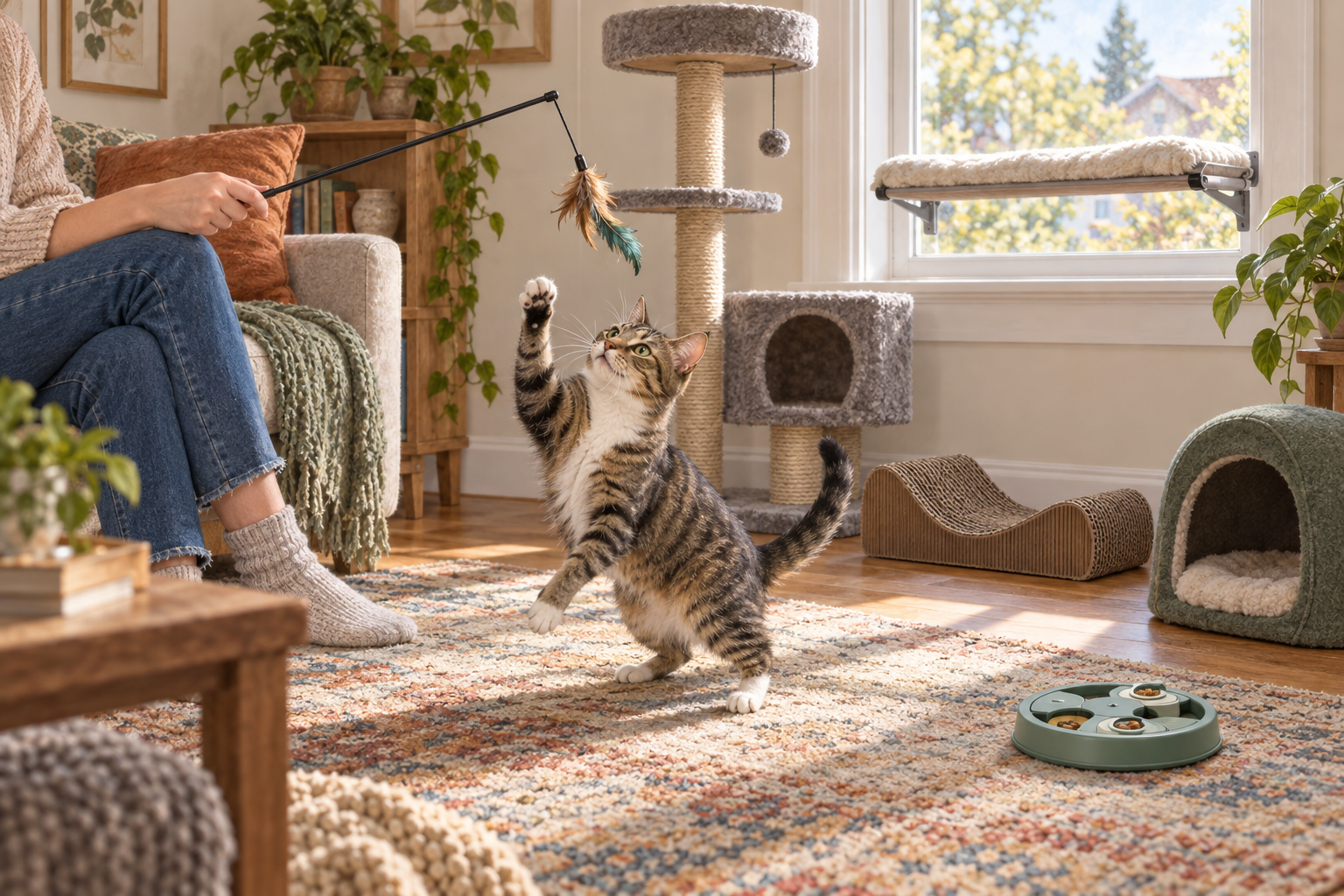
Rather than prescribing the same number of minutes for every cat, I watch the response. Start with a brief session while the cat is interested, move the toy like prey, allow successful catches and stop before frustration or exhaustion. Age, health and individual play style matter. Several short opportunities may suit some cats better than one long session.
Change what happens after the knock
If a harmless object reliably produces an excited human response, that response can become part of the reward. Make the area safe first. Then keep cleanup calm and brief. Do not turn the incident into chasing, feeding or an immediate play session.
Move attention and play to a predictable time before the usual trouble period, when the cat is calm. Reward the behavior you want to see: settling on the legal perch, touching an approved toy or staying on a mat. A station behavior can be built in small steps by rewarding a glance toward the mat, then one paw, all four paws and gradually a short stay.
Skip punishment and startling devices
Yelling, spraying water, chasing, startling mats and motion-triggered air sprays do not teach the cat which safe choice to make. They can add fear and may link that fear to a person, another animal or the location. Feline veterinary guidance recommends meeting environmental needs and teaching an alternative behavior instead of using aversive methods.
Run a one-week observation experiment
Change one likely cause at a time so the result is readable. For a crowded route, clear it and add a stable perch. For objects that provide movement, remove them and schedule safe object play. For a pattern that usually brings attention, provide interaction before that time and reward calm use of the alternative spot.
Record each incident without rounding the result into “good” or “bad.” Note the location, item, preceding event, response and what the cat did next. Progress may mean fewer opportunities, less persistence at one surface, or more frequent use of the approved perch. If nothing changes, revisit the function instead of adding a stronger deterrent.
When to get additional help
Ask a veterinarian for help when the behavior begins suddenly, creates repeated injury risk, occurs with physical or sensory changes, or appears alongside hiding, aggression, elimination changes or other signs of distress. If medical causes have been considered and environmental changes do not help, a veterinarian with behavior expertise or a qualified feline behavior professional can assess the whole setting.
Sources used for this guide
- AAFP and ISFM Feline Environmental Needs Guidelines
- AAFP Position Statement: Indoor/Outdoor Lifestyle for Cats
- Feline Veterinary Medical Association: Training Techniques for Addressing Undesirable Behaviors
- Ohio State University Indoor Pet Initiative: Environmental Enrichment
Editorial note: The indoor play illustration on this page was generated for DailyTrail to show the enrichment setup described. It is not a photograph of the author’s cat. This article provides general behavior information and does not replace veterinary or qualified behavior advice.