
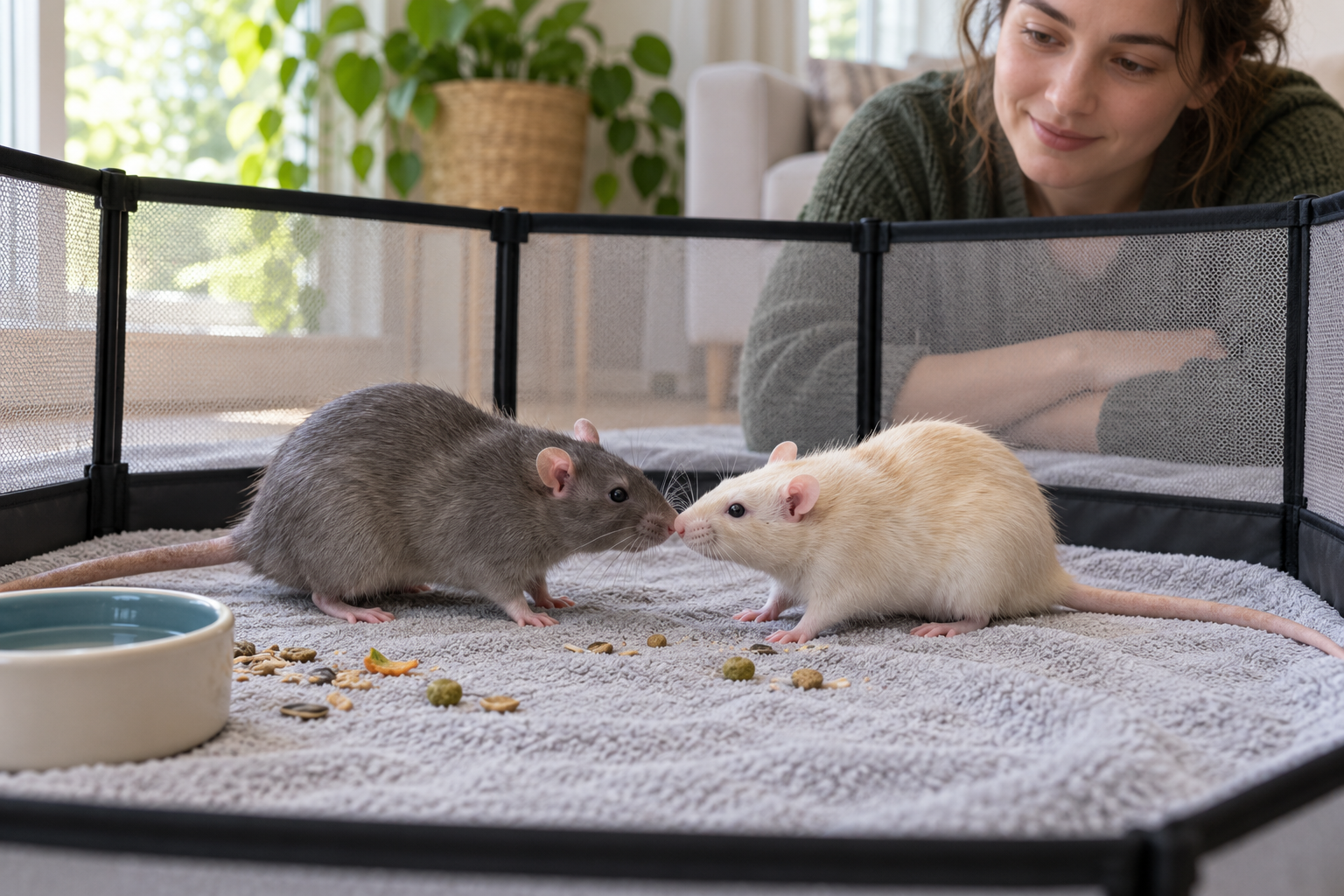
Two rats touching noses is easy to photograph. It tells you very little about whether they can share a home. I would watch what happens after that first investigation: can each rat move away, eat, and settle, or does one keep chasing the other into a corner? An introduction is going well when the animals have choices and begin to relax around each other, not merely when a meeting has lasted a certain number of minutes.
Rats are social animals, but adding an unfamiliar rat can disrupt an established group. The RSPCA's companionship guidance explains why stable groups and access to separate resources matter. If you are unsure about the rats' sex, health, or history, speak with a rat-experienced rescue or veterinarian before arranging contact. Do not place an intact male with a female and hope they will simply become companions.
Prepare before the rats meet
Keep the newcomer in suitable separate housing while you check health and agree on an introduction plan with a rat-experienced professional. Respiratory signs, wounds, poor appetite, or unusual lethargy deserve veterinary attention before a stressful meeting. Ask the rescue or vet how to manage any isolation period; the right approach depends on where the rat came from and the health of the resident group.
Set aside a time when you can stay nearby and continue watching afterward. Have a secure, ventilated neutral area ready, with non-slip footing, water, and a little of the rats' normal food spread out. It should not smell like one rat's established territory. A smaller, simple area makes each animal easier to see and leaves fewer objects to defend. Woodgreen Pets Charity describes both a supervised neutral-space method and a carefully staged small-space method; neither is a reason to leave unfamiliar rats together without observation.
You also need a safe way to stop contact if a fight develops. A towel or firm divider can create a barrier without putting bare fingers between biting animals. Keep separate secure enclosures available. If you have never introduced rats before, ask a rescue to demonstrate its method instead of improvising during a fight.
Watch the interaction, not the clock
Place the rats into the neutral space together and watch the whole group. Sniffing, brief squeaks, a short attempt to establish position, and moving apart again may occur. What matters is whether those moments end and the rats can resume ordinary behaviour. Record a few concrete observations: who approached, who moved away, whether one rat could reach water or food, and whether anyone settled or groomed.
Repeated chasing, a rat being trapped or prevented from leaving, fur raised during an attack, biting, or rats rolling together in a fight are reasons to intervene. Check both animals for wounds, including small punctures that can be hidden by fur. Woodgreen lists chasing, biting and “rat balling” among behaviours needing intervention; the RSPCA warns that persistent aggression or injury may mean the rats cannot safely share a group. Do not use “no blood yet” as a reason to let a frightened rat remain cornered.
One calm meeting does not prove that they are ready to live together. Follow the introduction method you chose with your rescue or vet, and move forward only when the rats repeatedly show relaxed behaviour. If conflict rises when the space expands or an object is added, return to the last calm stage and reassess. The timing belongs to the rats, not a universal day-by-day schedule.
Make the shared cage harder to guard
Before the group moves into one home, clean and rearrange the cage so it is less like one rat's defended territory. Start with accessible food and water in more than one place, clear routes, and enough space for rats to pass one another. Add furnishings in stages, watching whether a particular hide or narrow doorway triggers blocking. An enclosed house with two exits is easier to leave than a single-entry tube.
Our rat cage setup guide shows how to arrange solid levels, rest areas, and foraging routes. During introductions, keep the initial setup simpler than the finished cage. The RSPCA recommends multiple food and water points, shelters, and visual barriers; Woodgreen advises adding enclosed items only after the group has settled. The goal is for every rat to reach necessities without asking permission from the most assertive one.

Check what happens after you leave the room
For the first days in a shared space, look for more than a peaceful photograph. Are all rats eating and drinking? Does each have a dry place to sleep? Are there new scratches, missing patches of fur, or one rat spending long periods hidden from the others? Watch at different times, including when food appears and when the rats are active. Check each rat's body during the early introduction period; Woodgreen recommends injury checks during the first two weeks.
If a previously stable group suddenly starts fighting, check for a recent cage change and ask a rat-experienced vet about pain or illness. If one rat is injured, frightened, or repeatedly excluded, stop the introduction and get help. Some pairings need a different plan, and some are not safe to continue. Giving each rat a secure place while you seek advice is better than forcing a result.
Sources and further reading
- RSPCA: Keeping pet rats together
- Woodgreen Pets Charity: How many rats can live together?
- Woodgreen Pets Charity: Caring for rats as pets
- SPCA New Zealand: Caring for rats
Editorial note: The illustrations on this page were generated for DailyTrail to show the setups described. They are not photographs of the author's animals. This article provides general husbandry information and does not replace advice from a veterinarian familiar with rats.
[…] rats are also learning to share a home, keep handling sessions separate from introductions. Our guide to introducing pet rats explains how to watch their interactions with one another. After handling, return each rat to the […]
[…] and one rat hiding from another are more concerning than a brief disagreement that ends. Our guide to introducing pet rats explains which interactions need intervention. Even in a long-established group, new aggression can […]