
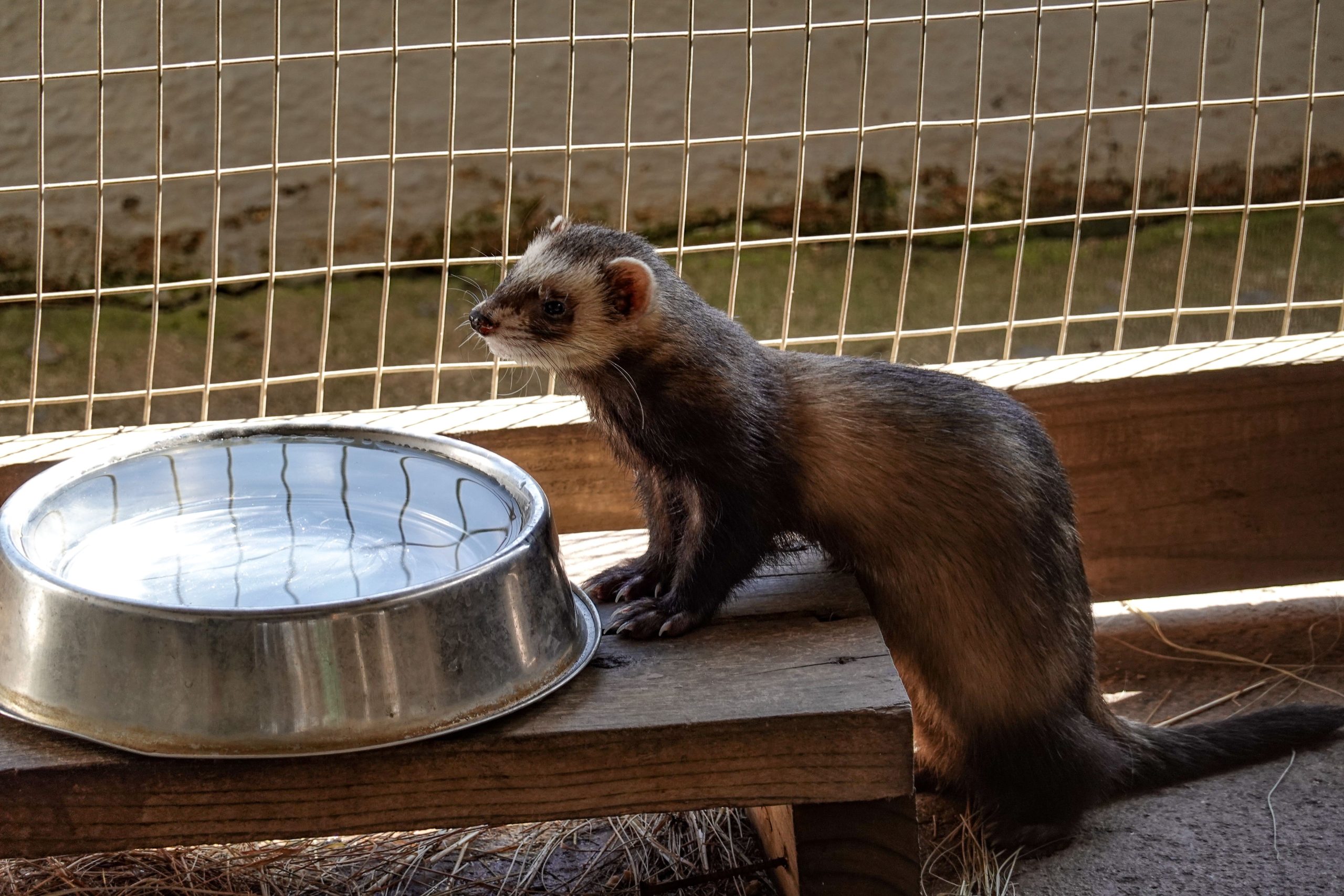
A ferret cage works best as a secure home base: a place to sleep, eat, drink, use the litter tray and stay safe when nobody can supervise. It should never be treated as the animal’s entire world. When I assess a setup, I look past the number of shelves and ask a simpler question: can the ferret move, rest and use each resource without slipping, falling or squeezing into trouble?
That distinction matters because a tall cage can look impressive in a product photo while offering very little usable floor space. A good arrangement combines enough room to turn and stretch with solid surfaces, secure doors, sensible separation between food and toilet areas, and a safe room for daily exercise.
Start with usable space, not the label on the box
Manufacturers use words such as “deluxe” and “multi-level” freely, so I would measure the actual interior. The Merck Veterinary Manual gives 3 feet wide by 3 feet deep by 2 feet high as a suitable cage size for a ferret while confined. Treat that as a practical starting point, then allow more room for additional ferrets and for a fuller set of resources. Shelves add interest, but they do not make up for a cramped base.
Wire sides provide ventilation, but the standing and walking surfaces should be solid or fully covered. Bare mesh can be uncomfortable underfoot and creates places for toes to catch. Ramps need a grippy surface, secure attachment at both ends and a gentle enough angle that an older or less agile ferret can use them. Any drop between levels should be broken up with shelves or hammocks rather than left as an open fall.
Check every opening with the smallest ferret in mind. Bar spacing, door gaps and openings around removable trays must not allow the head through. Test every latch from inside and outside; ferrets are persistent and can manipulate simple catches. A glass tank is a poor substitute because it limits airflow, and a cage that smells damp after cleaning is telling you that ventilation or drying time needs attention.
Arrange the cage around daily habits
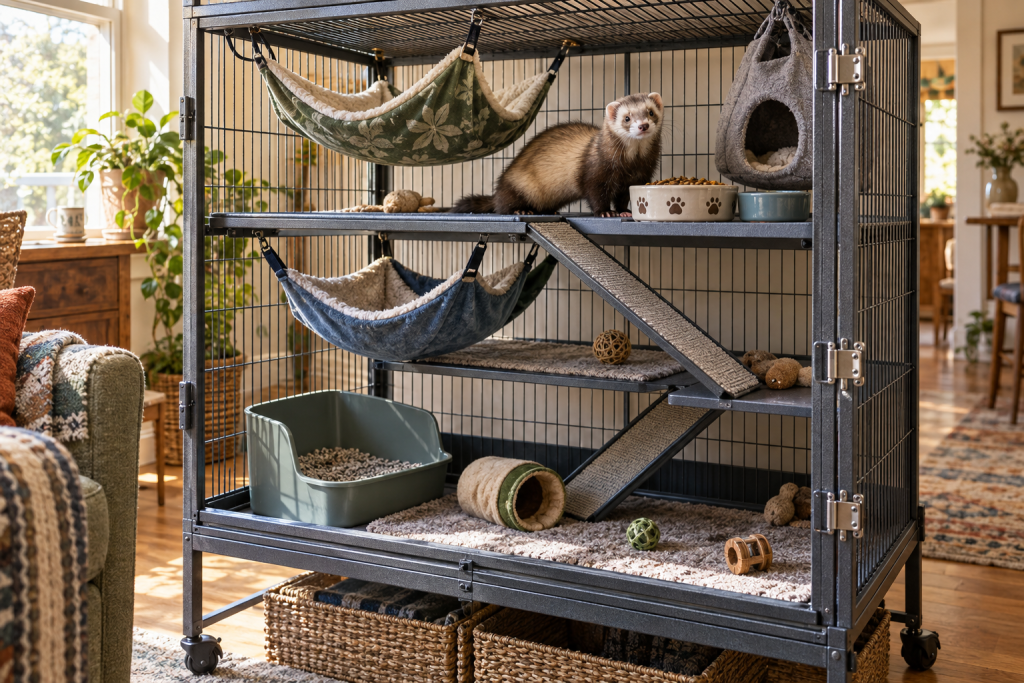
I prefer to plan the cage as four small zones rather than scatter accessories wherever they fit. Put a dark sleeping pouch or covered bed in the quietest part. Place a high-backed litter tray in the corner the ferret naturally chooses. Keep food and water away from that tray, and leave an open route between all three. For a pair or group, duplicate important resources so one animal cannot block another from water, food or a resting place.
Water should remain available at all times. A heavy bowl is easy to drink from but may be tipped or used for digging; a securely fixed bowl can solve that. If a bottle is used, check the nozzle daily and consider providing a bowl as well. The right choice is the one that stays clean, works reliably and suits the individual ferret.
For litter, use a low-dust, non-clumping product recommended for ferrets and make the tray large enough for the whole body. Merck advises keeping the litter box away from sleeping and eating areas. Scoop it daily and clean food and water containers daily. The RSPCA’s ferret housing guidance also recommends a well-ventilated, dry, draught-free home and regular cleaning of housing, play and resting areas.
Washable hammocks, tightly woven fleece and purpose-made sleep sacks are useful because they give shelter without loose fill. Inspect fabric during every clean. Frayed seams, exposed stuffing or missing pieces are reasons to remove an item immediately; swallowed material can cause a gastrointestinal obstruction. Avoid dusty wood shavings, straw and hay as cage substrate. Merck’s professional guidance notes that dust from these materials may irritate the upper respiratory tract.
Do one safety check before the ferret moves in
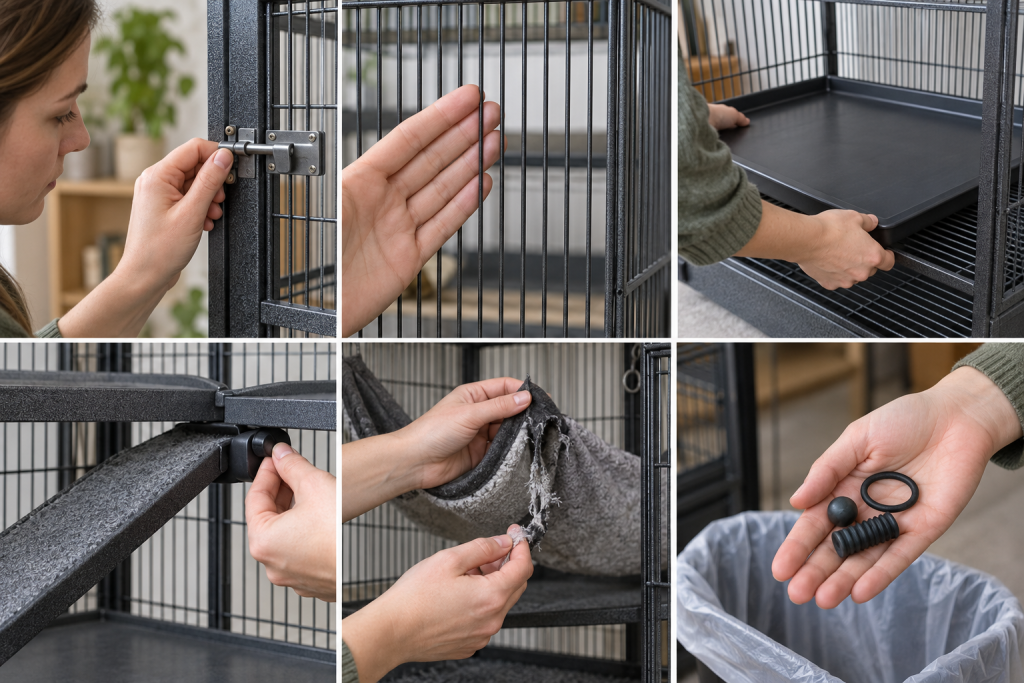
An empty cage is much easier to inspect. I would run a hand along cut wire and shelf edges, push firmly on every ramp, pull each door after latching it and look underneath removable trays. Then I would remove anything small enough to swallow or soft enough to tear apart.
- Cover all mesh floors and make sure the cover cannot slide.
- Remove foam, soft rubber, brittle plastic and toys with detachable parts.
- Replace frayed hammocks and check clips for sharp or open ends.
- Keep the cage out of direct sun, radiators and strong draughts; monitor the room rather than guessing from how it feels.
- Leave enough clear space that a ferret can move between resources without climbing over bowls or the litter tray.
Temperature deserves special attention because ferrets cope poorly with heat. The RSPCA suggests an environmental range around 15–21°C (59–70°F). If the room regularly rises above that range, move the enclosure to the coolest safe room and use reliable cooling rather than placing a frozen object in the cage and assuming the problem is solved. Panting, weakness, collapse or marked distress in warm conditions needs urgent veterinary help.
The home base must open onto a larger life
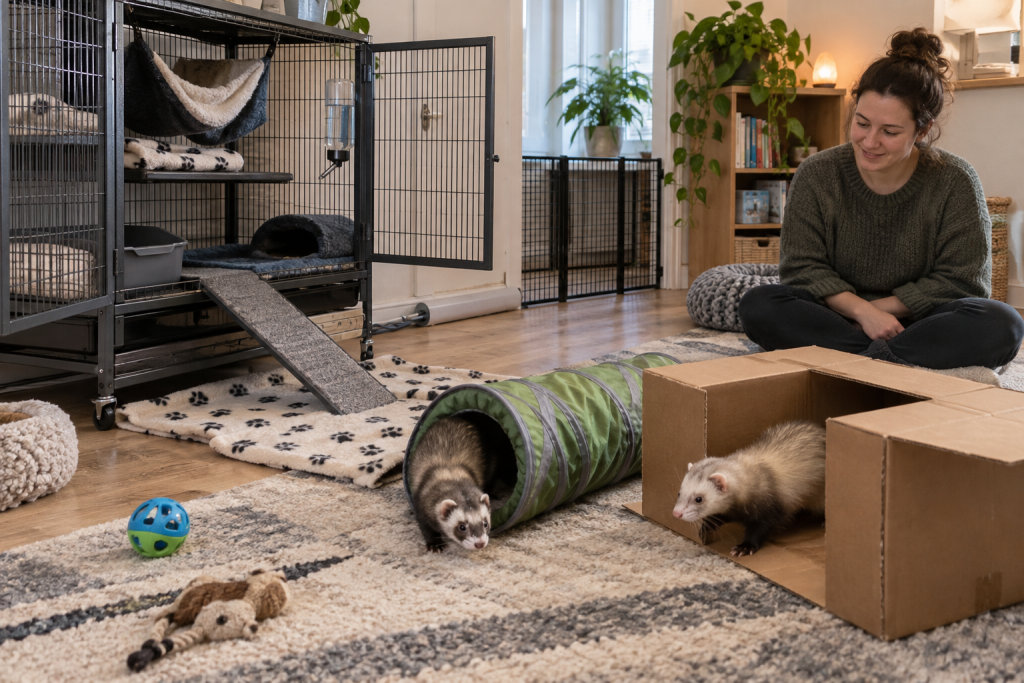
No cage layout replaces exercise and exploration. Merck recommends at least two to four hours outside the cage each day, supervised or in a ferret-proofed area. During that time, leaving the cage door open lets the animal return to water, food, litter and a familiar bed.
Ferret-proofing means getting down to floor level and following every possible route. Block access behind appliances and into vents, protect electrical cords, remove rubber bands and foam items, and prevent entry into reclining chairs or sofa mechanisms. Tunnels and cardboard boxes are useful because they support exploration without needing a crowded cage. Rotate a few safe items at a time and discard anything that starts to break apart.
Let the first week show you what to change
A neat setup on day one is only a draft. Watch which corner becomes the toilet, whether water is being spilled, whether one ferret guards a bed, and whether anyone avoids a ramp or repeatedly tests a door. Those observations tell you more than a product checklist. Move the litter tray to the chosen corner, add a second sleep space, change a steep ramp or strengthen a latch as needed.
Cleaning is also a useful inspection, not just a chore. Note changes in appetite, stool, urine, water use and activity while you replace bedding and wipe surfaces. A persistent change, signs of pain, breathing trouble, vomiting, repeated diarrhea, inability to pass stool, weakness or suspected swallowing of a foreign object warrants prompt advice from a veterinarian familiar with ferrets.
Sources used for this guide
- Merck Veterinary Manual: Providing a Home for a Ferret
- Merck Veterinary Manual: Management of Ferrets
- RSPCA: How to Create a Good Home for Ferrets
Editorial note: The illustrations on this page were generated for DailyTrail to show the enclosure arrangements described. They are not photographs of the author’s animals. This article provides general husbandry information and does not replace advice from a veterinarian familiar with ferrets.