
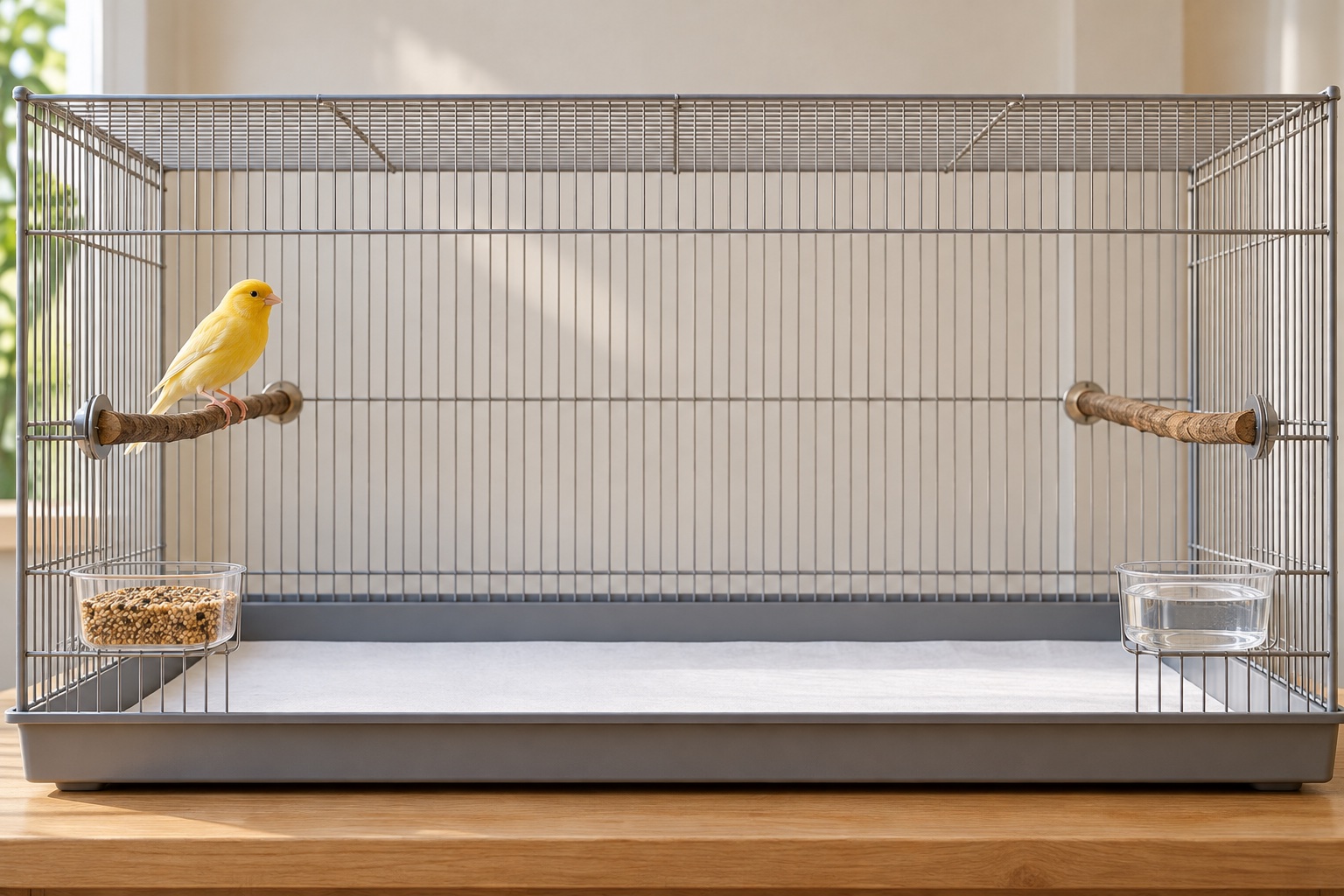
Before adding another perch, I would look at the space between the ones already there. A canary needs somewhere to land, but it also needs room to move its wings. A cage filled with attractive branches can leave very little usable flying space.
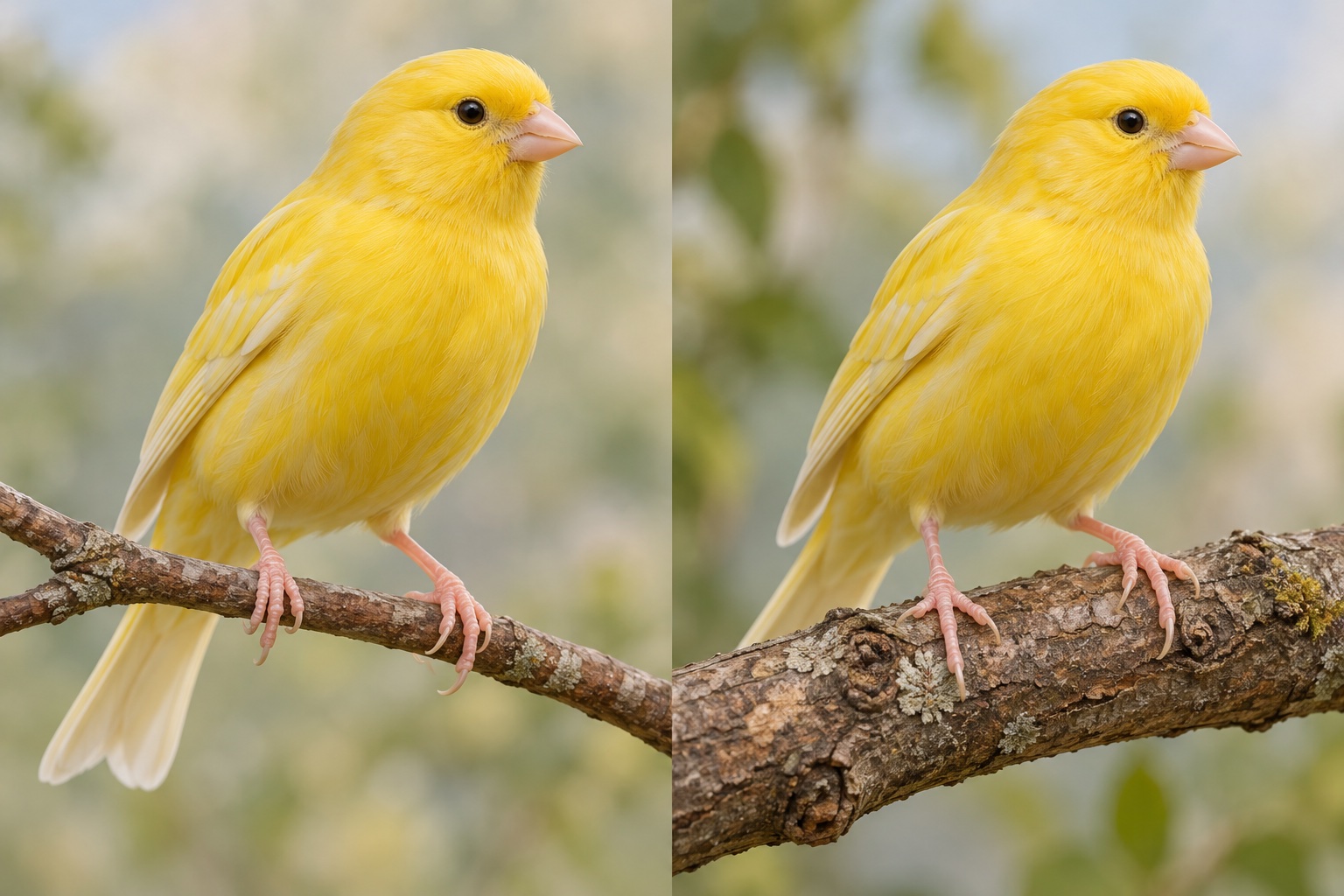
The other useful view is from the side, while the bird is resting. Look at its grip, the clearance behind its tail, and what sits directly underneath it. Those details tell you more about a perch than the words “natural” or “small bird” on the packaging.
For this guide, I would start with a simple layout, watch how the canary uses it, and change individual problems as they appear. A perch arrangement is something to check in use, rather than finish once and forget.
Choose the branch before choosing its position
Natural wood with modest changes in thickness provides different places for the feet to rest. A branch need not be dramatically crooked or covered in sharp bark to offer variety. Look for a sound surface without splinters, pointed broken twigs, sticky sap, or loose parts.
The supplied dowels can be useful as familiar landing places during a change, but I would avoid making every resting surface an identical smooth cylinder. The aim is a small selection of comfortable choices, not the largest possible collection of textures.
Buying a perch sold for birds is a starting point, not a complete safety check. Inspect the actual item, including its fittings, when it arrives. A product intended for a large parrot may be awkward for a canary even if the wood itself is suitable.
If you collect a branch, you need to know both the tree and its history. An unidentified garden cutting, a roadside branch, or wood from a sprayed tree is not a useful shortcut. Cleaning cannot turn toxic or chemically contaminated wood into safe material. Use a supplier who identifies the wood, or ask an avian veterinarian about a positively identified, untreated branch and suitable preparation. Do not apply household paint or wood preservative.
Let the bird’s grip guide the fit
There is no single diameter that can be prescribed for every perch and every canary. Start with branches intended for small songbirds, then observe the feet on the usable sections. The toes should be able to curve around and hold the surface without the bird repeatedly slipping or balancing awkwardly on top.
Watch a landing as well as a still photograph. Does the branch stay steady? Can the bird settle without repeated readjustment? Can it turn and leave again? A perch that looks acceptable while the bird is motionless may be difficult to land on if it rotates at the attachment.
A gentle taper gives the bird nearby positions with slightly different grips. It does not make every part of a branch appropriate. If most of the available landing surface is too bulky to grasp, choose another piece rather than waiting for the canary to become used to it.
Sandpaper sleeves are not a solution to long claws. They can abrade the undersides of the feet. I would leave them out of this setup, and also avoid using a harsh abrasive perch as the favourite overnight resting place. A canary whose claws catch or interfere with normal standing needs an assessment and appropriate nail care, not a rougher surface.
Leave the middle open
Plan the route before filling the cage. In a suitably spacious rectangular enclosure, landing places towards opposite ends can leave an open stretch between them. Avoid creating a ladder of branches so close together that every movement is a short shuffle through obstacles.
This is a layout principle, not a fixed perch count. The enclosure’s dimensions, the bird’s abilities, and any other occupants determine what works. Look along the proposed route from one landing place to the other: is there a branch, toy, feeder, or swinging object across it?
Leave clearance from the sides and roof so the canary can turn, stretch, and land without scraping feathers. Its tail should not be pressed against the bars when it rests. If you cannot provide clearance and a useful movement route together, removing one accessory may help, but an undersized enclosure needs more space rather than increasingly clever packing.
Perches cannot compensate for a lack of exercise opportunities. Flight provision needs to be considered as part of the bird’s wider housing, with any indoor flight taking place in a properly secured, bird-safe room.
Keep droppings out of the feeding area
Before tightening a perch, look straight down from it. Food bowls, drinking water, bathing water, and lower resting branches should not sit in the path of droppings. Moving a dish slightly can be simpler than adding more branches around a poor position.
Make sure the feeding position itself is usable. A bird should be able to reach its food and water without a large stretch or an unstable landing. Recheck after replacing a bowl with a different shape; the old perch position may no longer suit the new rim or opening.
A practical trial is to check the paper liner and dishes after the bird has used the arrangement. Repeated contamination in one place is information about the layout. Change that relationship, rather than accepting dirty water as an unavoidable feature of keeping a bird.
Test the fitting before the bird does
With the canary safely away from the work, install the perch according to its instructions. Check that the attachment cannot slide, twist, or leave a pointed screw accessible inside. Washers and fasteners must fit securely without creating an accessible trapping gap.
Apply gentle pressure in the directions a landing bird will load it. If the branch rolls, the fitting loosens, or the cage bars distort, stop and correct the installation. Do not use tape, hanging loops, or improvised cord to rescue an unsuitable mount.
Check doors and the removable tray before finishing. A branch that prevents normal cleaning will eventually encourage awkward workarounds. Keep the canary secure while tools and doors are in use; do not depend on the bird staying on the far side of an open cage.
I would keep the first arrangement easy to describe: a familiar resting place, an alternative landing place, accessible food and water, and a clear route between them. Additions should solve an observed need.
Introduce changes without taking away every familiar place
If the existing arrangement is safe, replace one perch at a time. Keep a familiar landing point while the canary investigates the new surface. Avoid putting a large unfamiliar branch across its usual route just before the room goes dark.
Watch from outside the cage without repeatedly reaching in to reposition the bird. Choosing the old perch initially does not prove the new one is wrong. Equally, repeatedly avoiding a landing area is a reason to inspect its stability, clearance, and approach, rather than trying to force contact.
Write down the change in plain terms: which branch moved, where it went, and what the bird did afterwards. “Landed twice, then slipped when turning” is more useful for the next adjustment than “doesn’t like natural perches.” If compatible birds share the enclosure, check that one cannot monopolise the only comfortable sleeping position. Do not add a companion simply to test the layout; canary compatibility requires separate planning.
Clean the surface and keep a replacement ready
Check perches during daily care, especially underneath the favourite sleeping position and beside fresh food. Remove soiling promptly. Take a dirty branch out for appropriate cleaning, rinse as required, and let it dry fully before returning it. Follow the cleaning product’s instructions and keep fumes and residues away from the bird.
Having a spare suitable perch makes this easier: a branch can dry properly without leaving the canary without a usable resting place. Mark the spare’s intended position if its fitting is specific to one part of the cage.
Cleaning is also the time to turn the perch over and inspect it. Replace wood that is splintered, deteriorating, mouldy, or no longer securely attached. Smooth-looking upper bark does not tell you whether the mount underneath has loosened. I would avoid rope in this basic canary arrangement because loose fibres add an entanglement hazard that a plain sound branch avoids.
Know when rearranging is not enough
Briefly resting with one foot tucked can be normal. Persistent avoidance of one foot, swelling, redness, sores, bleeding, repeated falls, or a change in the ability to grip needs veterinary attention. A bird that cannot perch, sits weakly on the floor, struggles to breathe, or stops eating needs urgent help from an avian veterinarian.
Do not repeatedly catch a canary to photograph the soles of its feet, and do not apply human creams, bandages, or medicines without veterinary instructions. A short video of its normal landing or standing can help explain the problem without extra handling. An injured or disabled bird may need a different support arrangement, planned around its condition.
When a layout is working, the evidence is ordinary: stable landings, accessible meals, clean water, and comfortable places to rest with room to move between them. Leave that useful space available instead of filling it simply because another accessory will fit.
Sources and further reading
- VCA Animal Hospitals: Perches for Birds
- University of Florida Small Animal Hospital: How to care for your pet bird
- UQ VETS: Care for your bird
- RSPCA Australia: How should I house my bird?
- VCA Animal Hospitals: Recognizing the Signs of Illness in Pet Birds
Editorial note: The illustrations on this page were generated for DailyTrail to show the perch arrangements described. They are not photographs of the author’s bird. This article provides general husbandry information and does not replace advice from an avian veterinarian.