
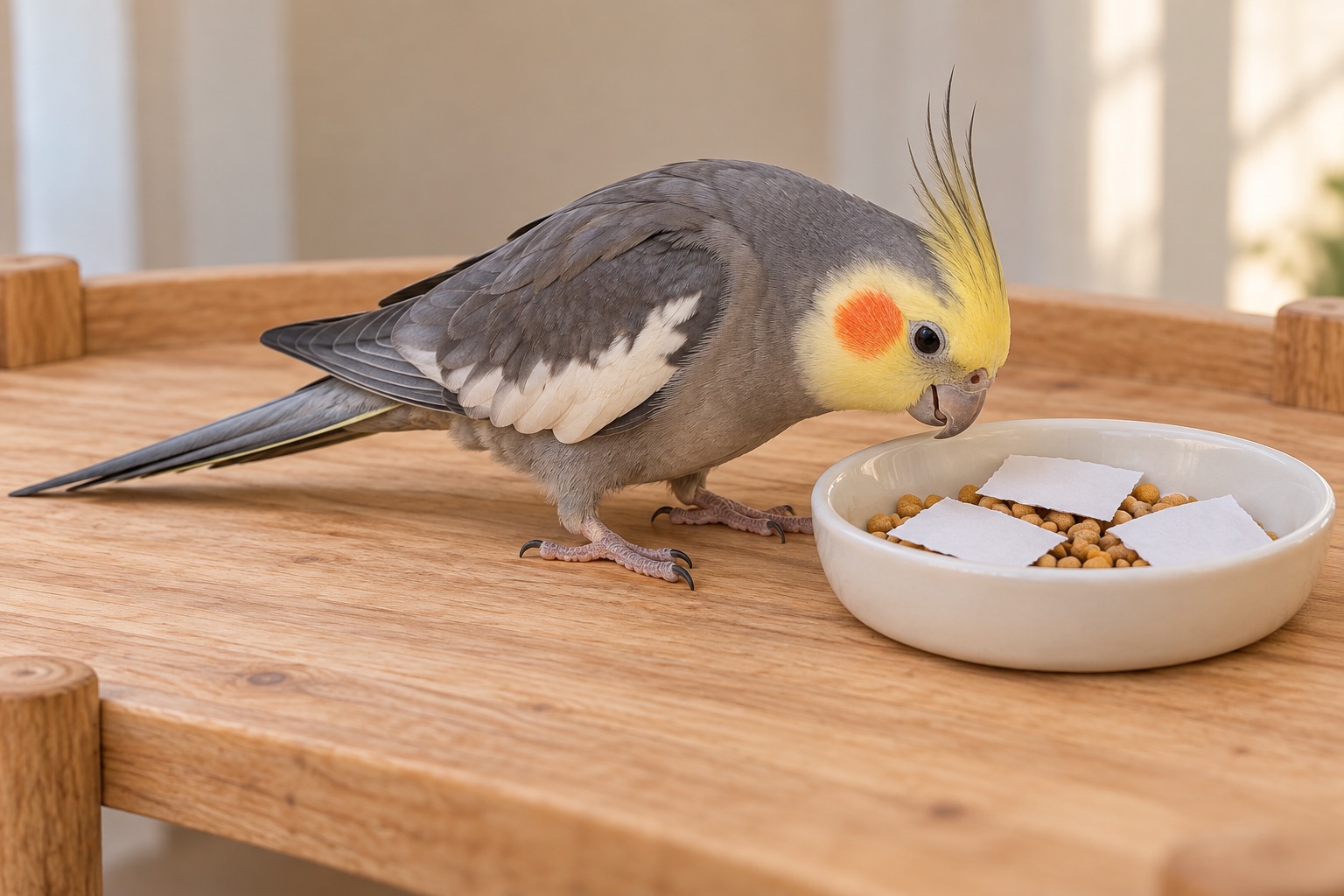
A dish with a few visible pellets and one loose piece of paper is enough for a first foraging lesson. Filling a tray with colourful objects may look more interesting to us, but a cockatiel still has to recognise the food, reach it comfortably, and feel safe enough to investigate. I would start with a setup that makes those three things easy to check.
This is a supervised introduction for a healthy cockatiel already eating reliably. It is not a way to make a reluctant bird eat a new diet. Keep its familiar food and fresh water readily available while it learns; access to a meal should not depend on solving a puzzle.
Choose a place the bird already uses
Begin beside a familiar perch or on a stable bird play platform, where your cockatiel can approach and leave without being picked up. A shallow dish is useful only if the bird can stand securely beside it and reach over the rim. For a bird with limited mobility, discuss an accessible arrangement with an avian veterinarian before adding obstacles.
Position the station away from overhead perches that collect droppings. Keep it clear of water bowls, sleeping places, cage door mechanisms, and the routes the bird uses to move around. Inside a cage, do not trade away flying or wing-stretching space to accommodate a large tray. Outside the cage, use a secured bird-safe room with doors and windows closed, fans off, other pets excluded, and no cooking fumes or accessible hot water.
A newly arrived cockatiel may be more concerned about the room than the activity. If it retreats as you approach, put the project aside and first work on predictable care and comfortable distance. Our guide to helping a cockatiel settle into a new home covers that earlier stage.
Gather less material than you think you need
For the first version, set out a shallow, stable, intact ceramic or stainless-steel dish, a small amount of food the bird already eats, and a little clean, plain, unprinted paper. Choose a dish with a smooth rim and no chips. Wash and rinse it thoroughly, then dry it before adding dry food. The surface underneath should not slide or wobble as the bird steps towards it.
Paper should be unscented and free of tape, staples, labels, glitter, coatings, and adhesive. Do not assume every packaging insert is suitable because it looks like cardboard. Reject greasy takeaway packaging, treated or fragranced material, mouldy storage boxes, and anything whose surface or previous use you cannot identify. Plain paper lets you see what has been chewed and is easy to replace.
For this beginner setup I would leave out string, rope, fabric strips, beads, bells, and loose hardware. They add inspection problems without making the first lesson better. Loops and gaps can trap body parts, frayed fibres can entangle toes, and detachable pieces may be swallowed. A commercially sold bird toy also needs checking for this particular bird; a product label does not remove that responsibility.
Do not fill the dish with sand, grit, dusty bedding, scented litter, or tiny decorative objects to create a treasure hunt. The aim here is a food-searching task whose contents you can account for, not a miniature habitat filled with material of uncertain safety.
Let the first reward remain visible
Place a few familiar pellets in the empty dish while your bird can watch. Step back far enough that your presence does not block the approach. If it eats comfortably, add one loose piece of paper beside the food, leaving the pellets uncovered. Allow the cockatiel to inspect, touch, or ignore it.
If the dish itself is unfamiliar, introduce that before adding paper. Put it at a distance that does not cause avoidance and bring it closer only while the bird remains comfortable. Do not push a tray towards a frightened bird or place it so that the bird must pass it to reach water.
Watch what actually happens. Walking over, taking food, and returning voluntarily tells you more than standing motionless near the dish. A bird that leans away, repeatedly retreats, or gives alarm calls needs more distance or a simpler presentation. Crest position alone is not a reliable verdict: consider posture, movement, and the surrounding situation together.
Add one small action, then watch again
Once eating from the station is familiar, lay a small paper square loosely over part of the food, with an edge exposed and some food still visible. Show the action by moving the paper aside yourself, then replace it lightly. The bird should be able to nudge or lift it without force. Do not tape the paper down or tightly wrap the meal.
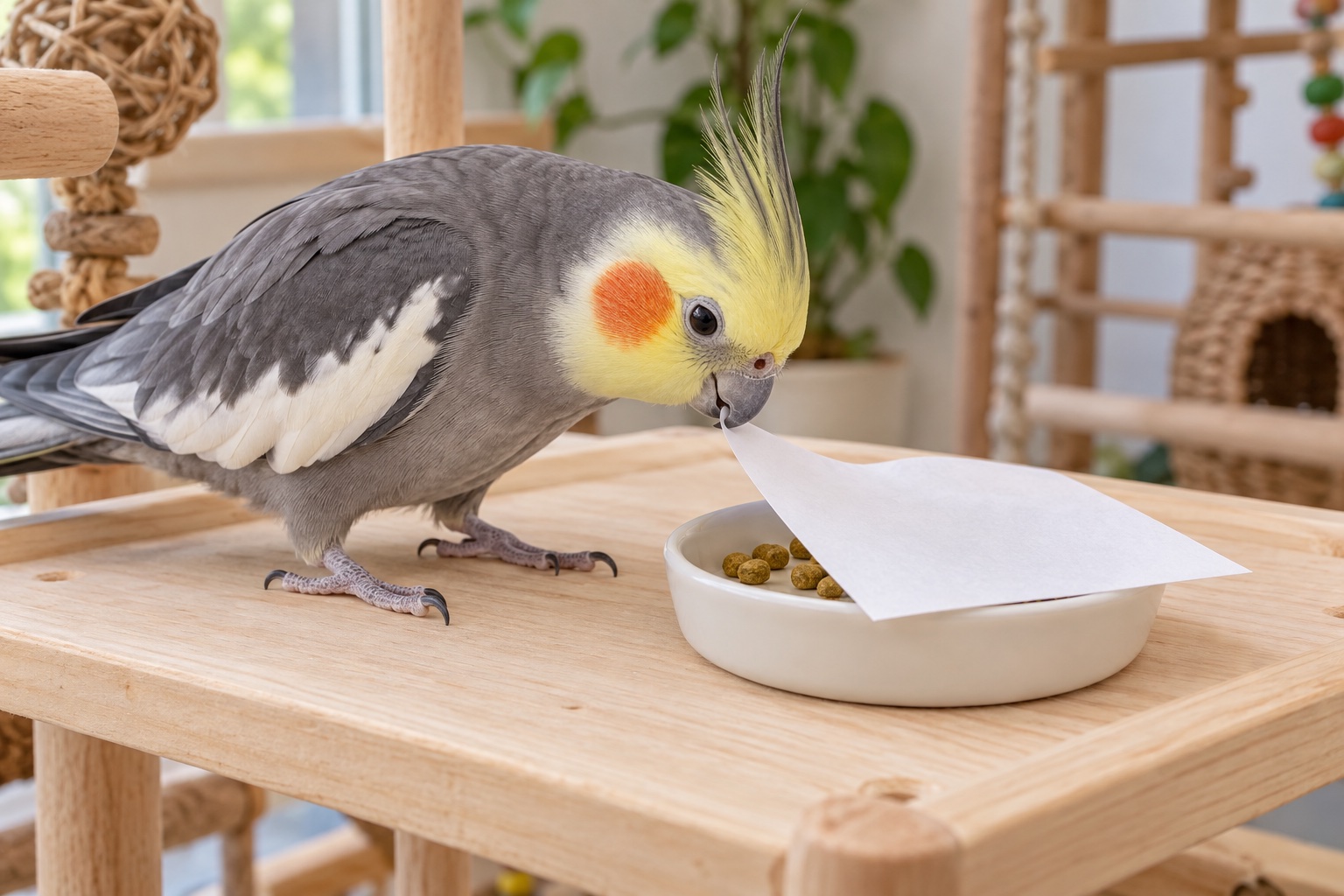
Progress might mean placing a pellet just under that edge, then trying a loose fold after the bird has repeatedly succeeded. Change one feature at a time. Increasing the amount of covering, changing the dish, and moving the station together makes it difficult to see what caused hesitation.
There is no deadline for reaching a closed parcel. A cockatiel that enjoys searching around a few loose paper pieces already has a useful activity. If it tears paper but never finds food, uncover the reward again. If it takes a pellet and leaves, let it leave. Repeatedly returning it to the station turns a choice into handling pressure.
Keep track of food, not just enthusiasm
Take the foraging portion from the bird's planned daily food rather than adding an unlimited stream of treats. Familiar pellets can be used if the bird recognises and eats them. A small preferred food may help demonstrate the task, but a station piled with millet does not become a balanced meal because it is called enrichment. Follow your avian veterinarian's feeding advice for the individual bird.
Avoid introducing a new food and a new puzzle at once. If neither is familiar, you cannot tell whether the problem is food recognition or access. Do not remove the normal food bowl to make the bird hungry enough to participate, and do not use this activity to force a seed-to-pellet conversion.
Check that food is actually eaten. Empty seed hulls can look like remaining food; scattered pellets may have been dropped rather than consumed. Note the food offered, what was eaten, and the bird's ordinary appetite. If it already accepts weighing calmly, maintain its usual weight records. A clear fall in intake, fewer droppings, or weight loss warrants prompt veterinary advice rather than a harder lesson.
Supervise the materials as they change
Stay close enough to observe the first sessions without looming over the bird. Paper that started as a flat sheet can become a wet wad or a torn strip. Remove soiled, wet, or damaged material promptly, and stop using it if the cockatiel appears to swallow non-food pieces. Do not leave an untested homemade arrangement overnight or assume that something used safely once will stay safe after chewing.
Empty the dish after the session, discard used paper, and wash, rinse, and dry the dish before reuse. Remove fresh food promptly before it spoils, sooner in warm conditions; do not bury moist vegetables under paper and forget them. Check the platform for food debris and droppings as well as the dish itself. Keep the next setup small enough that you can find every leftover.
If two birds use the area, watch access rather than assuming they share. A second station placed far enough away can help prevent one bird blocking the other, but it does not resolve persistent chasing or conflict. Each bird still needs reliable access to ordinary food and water.
Know when the activity is the wrong priority
An underweight, unwell, visually impaired, or physically restricted bird may need an adapted plan. Ask its avian veterinarian before making food harder to obtain. Foraging does not replace flight opportunities, social contact, sleep, or medical assessment of feather damage and other behavioural changes.
If your cockatiel suddenly stops eating, stays unusually fluffed and inactive, sits low or cannot perch normally, arrange veterinary help promptly. Breathing difficulty, collapse, suspected poisoning, or a swallowed object needs urgent attention. Remove the suspect material, keep details or a photograph for the veterinarian, and avoid improvised treatments.
For the next session, a useful note is quite specific: “ate visible pellets, moved the loose paper, left when the dish shifted.” That tells you to stabilise the dish and repeat an easy task. “Did not like foraging” gives you much less to work with.
Sources and further reading
- Medical Center for Birds: Foraging Behaviors—Getting Started with Enrichment
- RSPCA: Enrichment for pet birds
- RSPCA Australia: Keeping birds entertained and interested in their environment
- University of Florida College of Veterinary Medicine: Pet bird care, housing and enrichment
- VCA Animal Hospitals: Toys for birds and material hazards
- VCA Animal Hospitals: Recognizing signs of illness in pet birds
Editorial note: The illustrations on this page were generated for DailyTrail to show the setups described. They are not photographs of the author's animals. This article provides general husbandry information and does not replace advice from a veterinarian familiar with birds.