
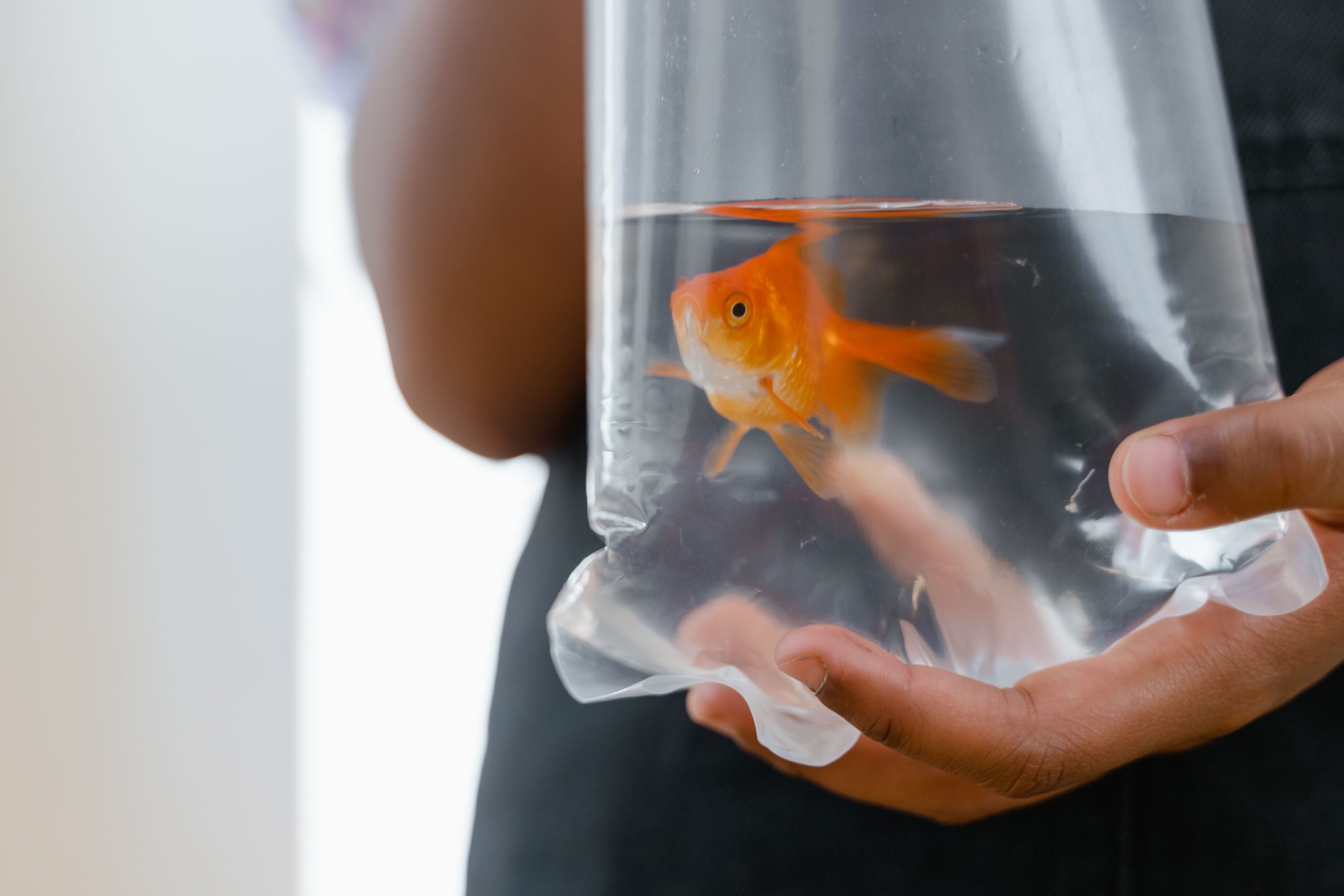
A clear goldfish tank can still have a water-quality problem. I would not decide whether to change water by how clean the glass looks, and I would not use a strict “never more than 30%” rule either. A useful routine combines regular partial changes with tests for ammonia, nitrite and nitrate. It also protects the biological filter, which is where much of the waste-processing bacteria live.
Start with a weekly routine, then use the test results
For an established aquarium, the RSPCA recommends a weekly partial water change of about 10–25%, with a gentle gravel clean. OATA recommends about 25% weekly for goldfish. Treat that range as a starting point, not a promise that any tank can safely wait seven days. A newly set-up tank, heavy stocking, more food or a filter problem may call for closer testing and a different response.
Test ammonia and nitrite regularly; both should be at or near zero. Track nitrate too, together with temperature and pH. Record the readings before each change and again when a fish behaves unusually. A log with the date, test results, amount changed and any new fish makes it easier to see whether the routine is keeping up with waste. Water that looks yellow, or water that looks perfectly clear, cannot replace a test.
If ammonia or nitrite is detected, check the filter, feeding and stocking rather than simply waiting for the next scheduled change. Seek prompt advice from an aquatic veterinarian or experienced aquarium professional if fish are gasping, weak or suddenly inactive. An emergency may need more substantial or repeated water changes; there is no universal 30% ceiling. In an old, severely neglected tank, however, abrupt chemistry changes can also be dangerous, so test the tank and replacement water and get case-specific guidance.
Prepare the replacement water first
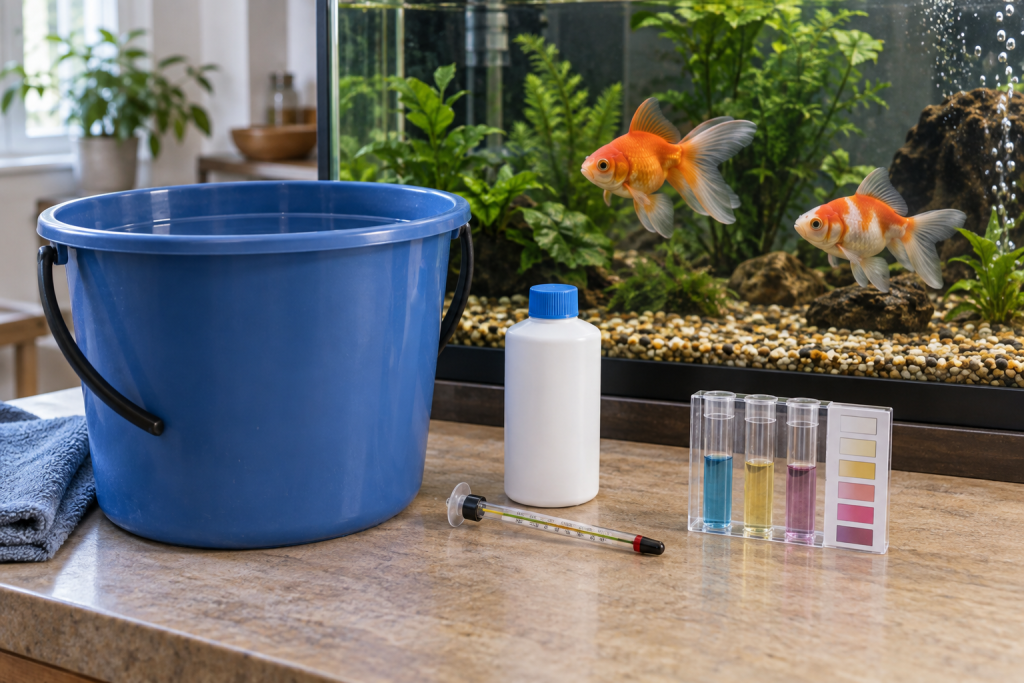
Use a bucket reserved for aquarium water, a gravel siphon and a thermometer. No soap, household cleaner or residue should reach the tank. Treat tap water with a conditioner that covers both chlorine and chloramine, following its label for the amount of new water. Leaving water to stand is not a reliable substitute for treating chloramine. Check that replacement water is close to the aquarium’s temperature; avoid sudden swings.
I would check the tap-water temperature and conditioner before removing water. That leaves less room for a rushed refill. If your source water has unusual pH, hardness or detectable ammonia, test it and seek advice before making a large change.
A calm partial change, step by step
1. Check the fish and equipment. Note whether the filter is flowing normally, the surface is moving, and the fish are breathing and swimming as usual. Test the water and write down the readings before you disturb the gravel.
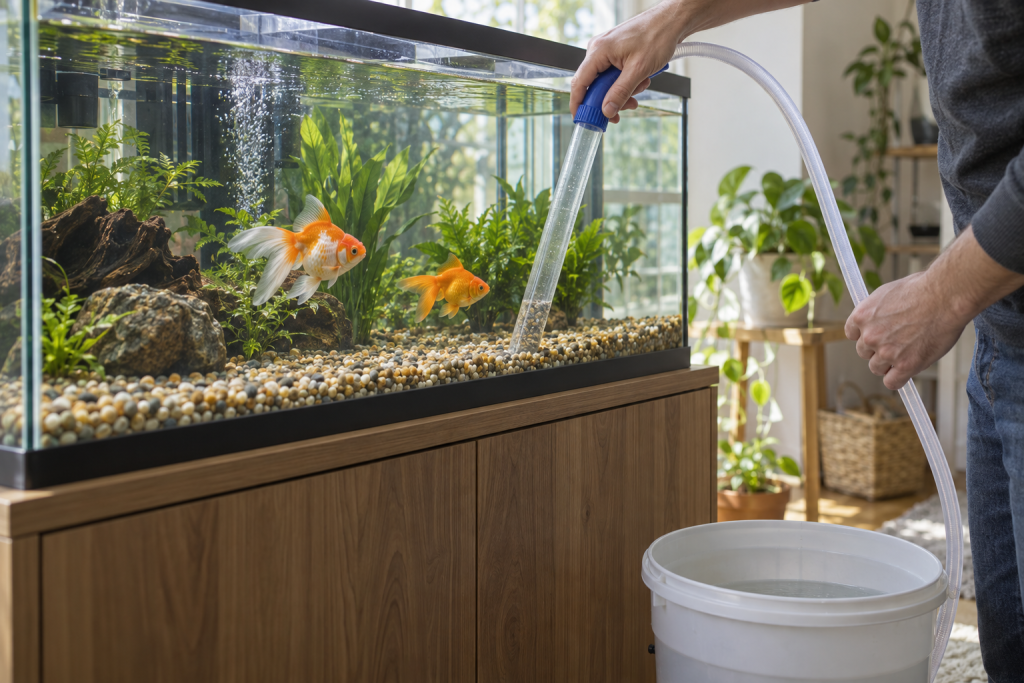
2. Siphon waste and old water. Keep the goldfish in the aquarium if they are safe there. Move the siphon gently over areas with visible waste or uneaten food, and avoid chasing the fish. Never start a siphon by mouth. Stop when you have removed the planned portion; you do not need to strip every patch of substrate in one session.
3. Tend the filter only if it needs it. Check for a clogged intake or reduced flow. If media needs rinsing, swish it lightly in some removed tank water. Do not scrub or replace all biological media at once, and do not rinse it under untreated tap water. Replacing water does not, by itself, erase the nitrogen cycle; damaging the established filter bacteria can.
4. Refill slowly and check again. Add the conditioned, temperature-appropriate water without pouring it directly onto a fish or stirring up the whole bottom. Restart or verify the filter and any aeration equipment, and make sure normal surface movement returns. Record how much water you changed.
What to watch after the refill
Spend a few minutes observing the fish. New gasping, rapid gill movement, loss of balance or unusual stillness calls for an immediate water test and a check of temperature, conditioner use and equipment. These signs have several possible causes; do not assume the last water change explains them all. If a fish remains distressed, contact an aquatic veterinarian.
If nitrate keeps climbing between weekly changes, the answer may involve more frequent partial changes, less excess food, better filtration or more swimming space. Topping up evaporated water does not remove accumulated waste. Keep the routine simple enough to repeat, but let the measurements tell you when it needs to change.
Sources
RSPCA: How should I care for my goldfish?; OATA: How to look after goldfish in an aquarium; Merck Veterinary Manual: Management of Aquarium Fish.
Editorial note: The illustrations on this page were generated for DailyTrail to show the setups described. They are not photographs of the author’s fish. This article provides general aquarium care information and does not replace advice from an aquatic veterinarian.
[…] not fix it. If the test results are abnormal or the maintenance history is unclear, follow these goldfish water-change steps to plan a measured change without shocking the fish. Record when the behavior began, what food and […]
[…] fast, reduce feeding while addressing the water problem. Use the step-by-step checks in this goldfish water-change guide; do not compensate for poor water by relying on a weekly fasting […]