
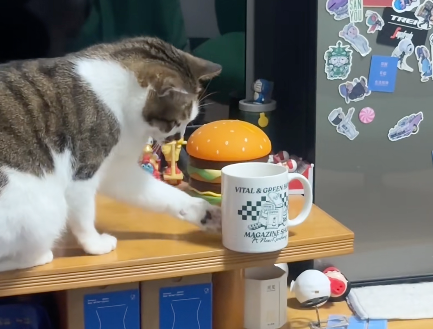
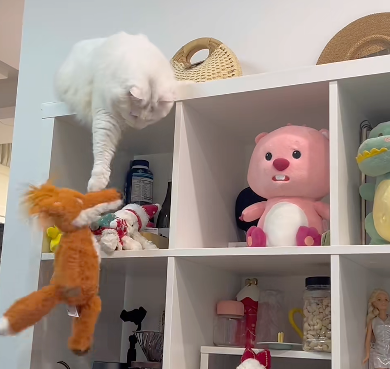
Two in the morning. A crash. You bolt upright in bed, stumble through the dark to the living room — your water glass is on the floor, water spreading across the rug, and your cat is sitting on the shelf looking at you like they had nothing to do with it.
Do not ask me how I know.
I have a cat that is genuinely talented at this. The precision. The patience. He will sit and stare at a cup for three full minutes before giving it one casual little nudge. Like he is conducting an experiment.
Took me a while to realize — he is not trying to annoy me. He just literally cannot help himself.
Why Do They Do It?
Cats do not knock things over because they are bad. And they are not trying to make you clean up at midnight.
It comes down to a few things:
Leftover hunting instinct. In the wild, cats paw at small animals to check if they are alive. That pen holder on your desk? Your cat sees a shape roughly the size of a mouse. They are not trying to break it. They are inspecting.
Boredom. A cat with not enough activity and mental stimulation will find their own entertainment. Knocking things over gives feedback — sound, motion, reaction. Way more interesting than lying around.
Attention-seeking. They figured out one thing: when I knock this off the table, the human looks at me, comes over, talks to me. That is better than being ignored.
So the fix is not “teaching the cat to be good.” It is removing the urge to knock in the first place.
The Simplest Fix — Remove the Target
Let us be honest here — if a cat can reach something, they will eventually knock it over.
So the most direct solution is not training. It is physical separation.
Move breakables away from edges. Cups go in the middle of the table, not near the edge. Books do not lean against the edge of a shelf. Decorations go where paws cannot reach.
Here is a practical rule: if something is within 4 inches of the edge of any surface, it is a candidate for being swiped off. Either push it back or move it somewhere else.
Televisions. I want to say this separately. If your TV is not secured to a stand, and your cat can jump up beside it — you are going to end up buying a new TV.
Sticky Pads and Museum Putty
For things that cannot be moved, stick them down.
Double-sided tape or non-slip mats go under small items — remotes, pen holders, little decorations. The cat paws at it, it does not budge. They lose interest fast.
Museum putty is a lifesaver. The stuff they use to secure fragile art pieces. It does not damage surfaces, but it holds things in place. Put a little under vases, picture frames, trophies. Cat pushes, nothing moves. You relax.
Give Them a Better Target
Cats have an urge to paw at things. You cannot remove the urge. But you can redirect it to something that is actually theirs.
Lightweight balls or ping pong balls on a flat surface. When the cat bats them, they roll and rattle — way more interesting than a heavy coffee mug that barely moves.
Track toys — those ones with a ball inside a circular track. Cat paws at it, the ball goes around, more noise, more motion.
When a cat has a better option, they usually leave the boring cup alone. Not because they learned manners. Because the cup is just not as fun.
Drain the Energy
A tired cat does not knock things over. A bored cat does.
If you give your cat one solid hunting-style play session daily — a wand toy mimicking prey movement, hiding, pouncing — for 10 to 15 minutes, their interest in your tabletop items drops noticeably.
I have mentioned this before in other contexts, but it applies here too. Not every cat needs to knock things over. Only cats with energy they have not burned.
Clear Surfaces Before Bed
This one is simple but easy to forget. Before you go to sleep, clear the kitchen counters and tabletops.
Cups, bowls, keys, glasses, pens, remotes — put them away. If your cat is most active at night, and you leave things out, the odds of a crash are nearly certain.
Take fifteen seconds to put things in a drawer or cabinet. In the morning, you take them out. The loss is fifteen seconds of your time. Not a broken cup and a ruined night of sleep.
Do Not Punish
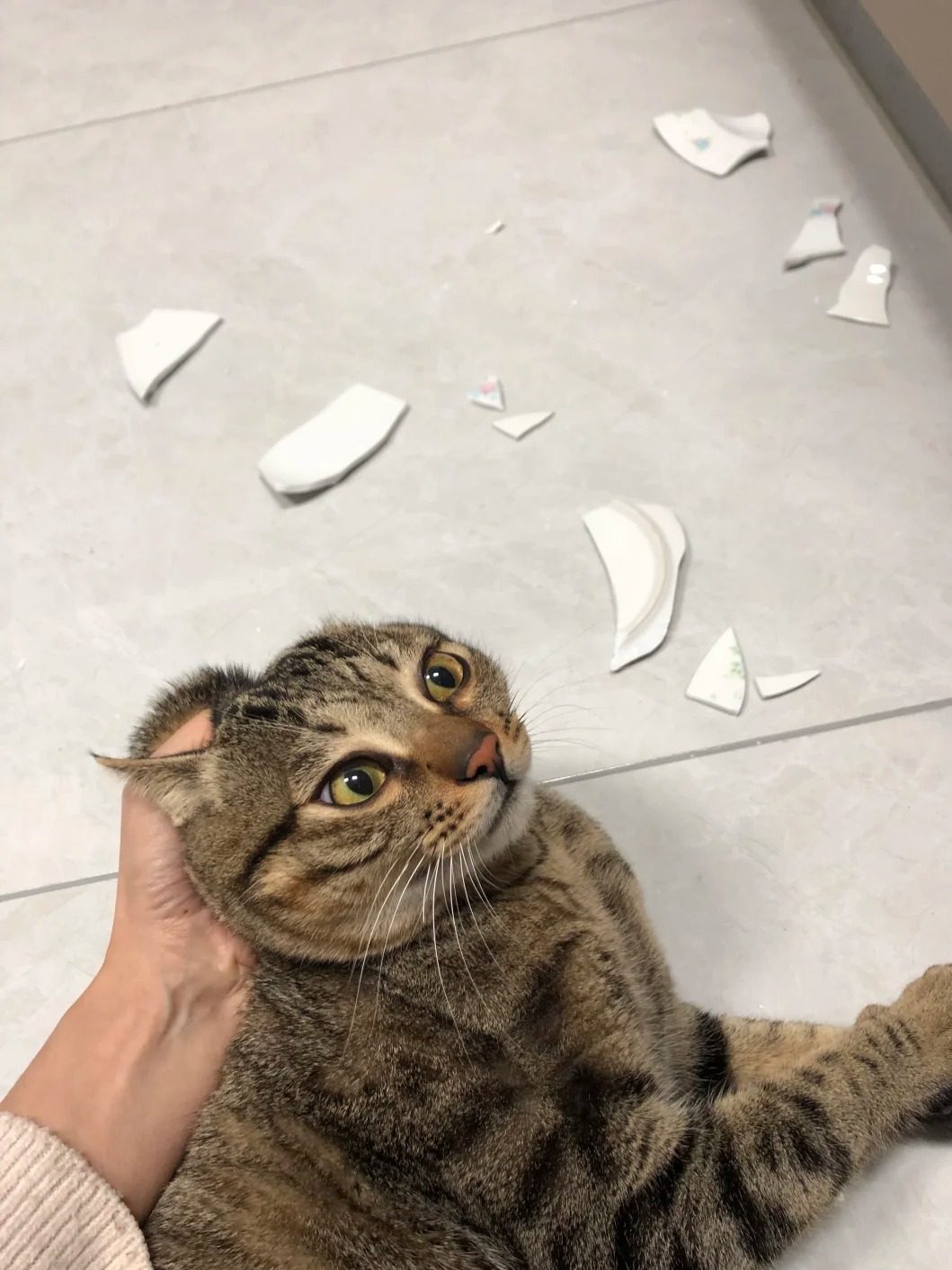
If your cat knocks something over and you yell, chase, or lock them up — they are not connecting “knocking things over” with “punishment.” They are just learning to be scared of you.
Worse: punishment teaches them to do it when you are not around. Because when you are watching, you get upset. When you are not watching, nothing happens.
So the rule is: clean it up. Move on. Do not react. Then move the item somewhere safer so they cannot reach it again.
Eight: A Trick That Worked for Me
My cat used to knock over a desk lamp at 3 AM like clockwork. I moved it. He found a new angle. I moved it again. He adapted.
What finally worked was a motion-activated air spray — a little can that lets out a short puff of air when the cat gets too close. Harmless, but cats hate it.
Two weeks later, he stopped going near that spot. I put the lamp back where it started. He never touched it again.
Not a magic fix for every situation. But if your cat has one specific spot they always target, disrupting the habit with something like this can break the cycle.
Final Thoughts
You will not reason your cat out of knocking things over. But you can reduce it to nearly zero with smart placement, better alternatives, and drained energy.
You cannot change their instincts. But you can move your cup four inches back from the edge. Cat cannot reach it. You sleep through the night. That is a fair trade.